
The Hidden Reasons Behind Bottle Failure and How to Fix Them
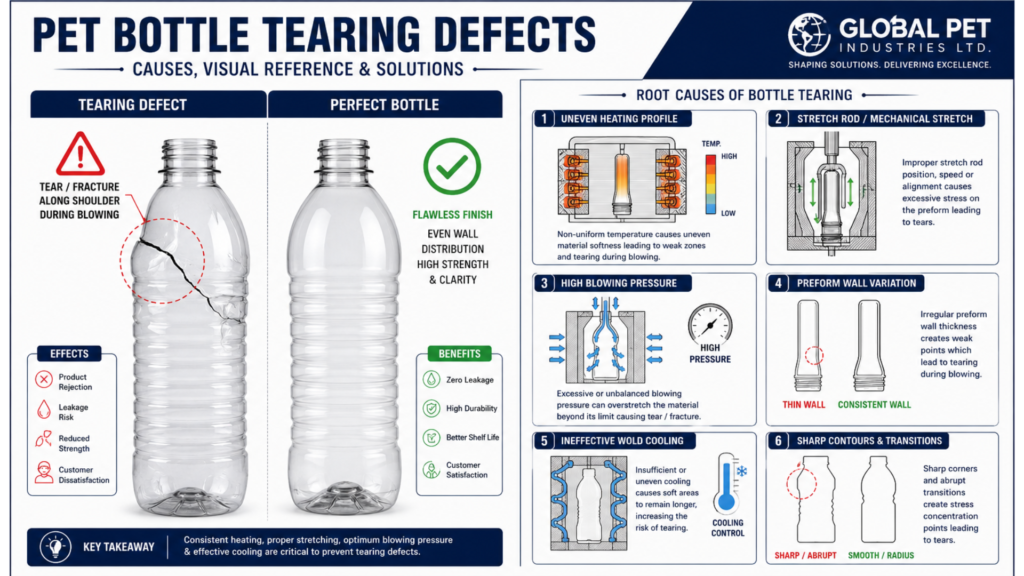
The Hidden Reasons Behind Bottle Failure and How to Fix Them: Eliminating PET Bottle Tearing Engineering Insights Troubleshooting Guide A PET bottle that tears or bursts during high-pressure blowing represents a major operational failure. It directly erodes factory margins, drives up rejection rates, and leads to costly downtime on high-speed filling lines. When bottle tearing occurs, plant operators often assume the blow moulding machine is at fault. However, bottle tearing is rarely caused by a single mechanical glitch. It is usually the result of multiple compounding variables—including preform quality, oven heating profiles, bi-axial stretch ratios, air pressure timing, mould cooling channels, and overall process parameters. Understanding the root cause behind bottle tearing is essential for eliminating scrap, maximizing material efficiency, and securing smooth production runs. The True Operational Impact of Structural Tearing A single torn bottle disrupts the entire line cycle. In automated plants, high scrap rates trigger a ripple effect of hidden financial losses across operations: ❌ Resin Material Waste ❌ Production Capacity Loss ❌ Increased Machine Downtime ❌ Spiking Rejection Rates ❌ Costly Client Complaints What Does Bottle Tearing Mean? Bottle tearing occurs when the PET material ruptures under high-pressure expansion during stretching and blowing. The rupture location provides clear diagnostic clues about process conditions inside the mould: Shoulder & Transition Zone Under the Neck Ring Base & Petaloid Cavity Along the Sidewall Deep Grooves & Corners Every tear reveals specific mechanical or thermal imbalances happening during expansion. Below are the 7 primary root causes of bottle tearing and the exact engineering steps needed to solve them. 01. Uneven Preform Heating Inconsistent thermal conditioning across the preform body is one of the leading causes of bottle rupture. When one side of a preform absorbs more infrared heat than another, it stretches faster during pre-blow, creating localized thin spots that burst under final high-pressure blowing. ⚠️ Common Symptoms Bottles tear repeatedly on the exact same side Severe wall thickness variation across quadrants Visible white stress marks (stress whitening) prior to rupture ⚙️ Engineering Solutions Optimize infrared lamp power settings per heating zone Check reflector alignment to ensure heat focus Verify smooth preform rotation inside the oven chain Monitor ambient temperature and oven ventilation stability 02. Overstretching the Material Lightweighting reduces resin costs, but pushing preforms beyond their natural stretch limits leads to severe wall thinning and material breakdown, significantly reducing tear resistance. ⚠️ Root Cause Mechanics Exceeding natural bi-axial stretch limits Excessive thinning across high-expansion bottle zones Degraded molecular orientation and structural integrity ⚙️ Engineering Solutions Maintain balanced longitudinal and hoop stretch ratios Select an optimal preform weight and length for the container size Run finite element stress analyses before final lightweighting 03. Poor Preform Quality Even advanced blow moulding machinery cannot correct defective raw preforms. Inconsistent preform injection leads to inherent structural micro-cracks that fail under high pressure during blowing. ⚠️ Common Preform Flaws Moisture absorption due to inadequate drying before injection Weight and wall thickness variation between preform lots Crystallized or damaged gate areas Thermal degradation during injection moulding ⚙️ Engineering Solutions Source preforms from certified, high-precision manufacturers Audit incoming preform batches for weight and gate consistency Ensure preforms are stored in temperature-controlled environments 04. Excessive Blowing Pressure Increasing air pressure does not resolve underlying structural defects. Applying maximum pressure too early in the cycle over-stresses warm PET material, causing sudden ruptures. ⚠️ Pressure Hazards Excessive pre-blow pressure forcing rapid, uncontrolled expansion Immediate high-pressure blast tearing thin sidewalls Severe stress concentrations around sharp geometry transitions ⚙️ Engineering Solutions Precisely adjust pre-blow air pressure and timing sequences Calibrate final high-pressure timing based on bottle wall profile Maintain recipe parameters specific to container geometry 05. Incorrect Stretch Rod Timing The mechanical stretch rod guides preforms along the center axis prior to high-pressure air entry. Misaligned or uncalibrated stretch rod movement creates uneven wall distribution and weak points that tear during blowing. Synchronize Stretch Rod Timing: Align stretch rod movement with pre-blow air initiation. Audit Servo Settings: Ensure linear stretch speed matches preform stretch characteristics. Inspect Mechanical Centering: Verify stretch rods enter preforms along a straight center axis. 06. Sharp Bottle Design Features Complex container features like deep handgrips, sharp structural ribs, or aggressive base contours force PET material to stretch thin across sharp angles, creating localized stress points that rupture during expansion. Optimize Transition Radii: Replace sharp internal angles with smooth transition curves. Redistribute Material Flow: Adjust preform heat profiles to drive more resin into deep ribs. Conduct Material Distribution Analysis: Use 3D simulation tools to evaluate stretch behavior before tooling. 07. Poor Mould Cooling Performance Effective cooling sets the bottle geometry and locks in structural strength. Uneven cooling water flow through the mould causes localized heat retention, leaving warm areas soft and prone to tearing when ejected under internal pressure. Maintain Clean Coolant Channels: Flush cooling channels regularly to prevent scale buildup. Monitor Flow Rates & Delta T: Ensure consistent chilled water flow across both mould halves. Verify Base Chill Quality: Keep base cup cooling loops clear to secure structural strength. The Financial Impact of Bottle Tearing For high-speed beverage and packaging operations, a seemingly small 2% scrap rate leads to significant financial losses over time. Beyond wasted resin, bottle tearing incurs hidden costs from compressed air usage, electrical heating energy, downtime labor, and unfulfilled production targets. Eliminating tear root causes directly restores manufacturing profitability. How Modern Servo Blow Moulding Technology Helps Transitioning from legacy pneumatic systems to advanced fully automatic servo-driven blow moulding equipment eliminates standard processing variations. Servo-controlled architectures deliver repeatable operational control: Precise Heating Consistency Exact Servo Stretch Rod Control Stable Air Sequence Timing Lower Scrap & Rejection Rates Higher Daily Production Yields Optimized Utility Efficiency Partnering with Global PET Industries Ltd. At Global PET Industries Ltd., we resolve bottle failures through engineering precision rather than guesswork. Our technical teams work directly with plant managers to analyze preform performance, optimize heating profiles, and adjust blowing parameters for maximum stability. Eliminate Bottle Defects & Boost Production Yields Is bottle tearing, wall thinning, or high scrap
Why PET Bottles Fail: Root Causes, Engineering Solutions.
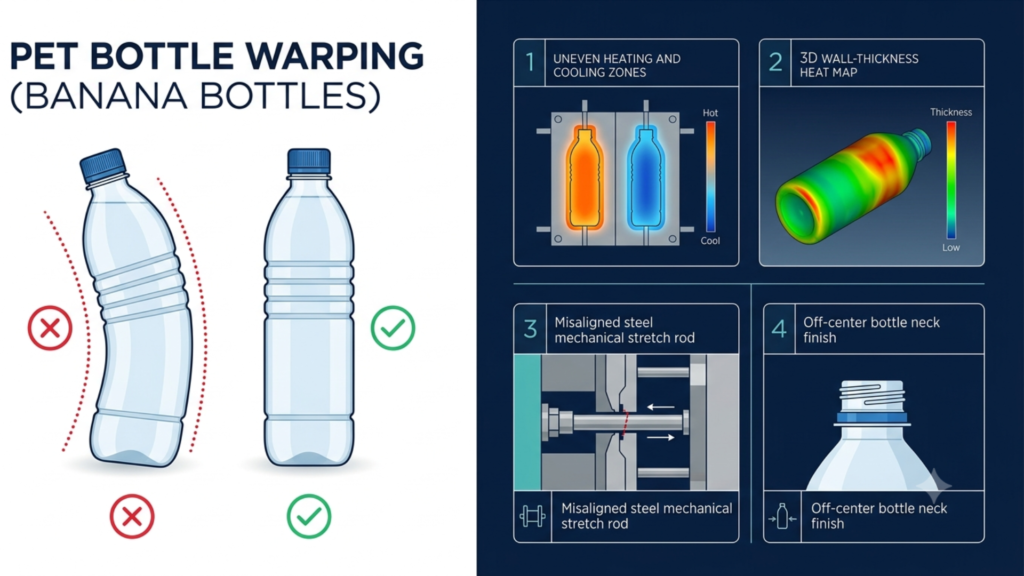
Why PET Bottles Fail: Root Causes, Engineering Solutions Engineering Insights Technical Guide Every high-performance PET bottle that rolls off a production line represents a complex balance of heat mechanics, volumetric compression, and sequence timing. When these operational inputs shift out of sync, rejection rates climb—eroding plant profitability. In high-speed packaging, even minor process fluctuations can trigger structural or aesthetic defects. This increases scrap ratios, wastes raw material, and leads to expensive client rejections. Correcting these failures requires looking past surface symptoms to identify and resolve the underlying engineering root causes. 01. Why Does Air Consumption Keep Increasing? High-pressure compressed air represents one of the largest continuous utility expenses on the plant floor. A sudden or gradual spike in air consumption signals system inefficiencies that directly drive up per-unit production costs. ⚠️ Common Root Causes Pneumatic leakage across fittings, seals, or high-pressure blowing valves Sub-optimal air recovery system bypass calibration Setting excessively high blow pressures for simple bottle geometries Extending high-pressure blowing cycles beyond technical requirements ⚙️ Engineering Solutions Implement rigorous ultrasonic leakage audits across high-pressure pathways Optimize blow pressure limits matching exact container specifications Integrate advanced, modern air recovery units to capture and repurpose exhaust air Utilize precision servo-controlled blowing manifolds to reduce dead-space volume 02. Why Do Banana Bottles Occur? A “banana bottle” is a defect where the container bends or warps off-axis after ejecting, failing to stand perfectly upright on flat conveyor lines. This completely disrupts high-speed filling, labeling, and packaging workflows. ⚠️ Common Root Causes Uneven or unbalanced cooling across different mould cavity halves Non-uniform preform heating causing material thickness variance Physical misalignment of the mechanical stretch rod An off-center preform position prior to stretch initiation ⚙️ Engineering Solutions Ensure balanced, clean coolant flow loops through both mould halves Adjust and optimize multi-zone infrared heating profile settings Verify mechanical stretch rod alignment using precise calibration tools Check preform feeding mechanisms to secure centered entry every cycle 03. Why Do Lightweight Bottles Collapse? While lightweighting is critical for reducing resin material costs, reducing wall thickness without correcting your process profile can compromise top-load strength, leading to structural failures under load. ⚠️ Common Root Causes Poor bi-axial material distribution during the blowing phase Low orientation crystallinity caused by running too cool Sub-optimal geometric rib or base design for lighter weights Exceeding recommended filling temperatures for the material structure ⚙️ Engineering Solutions Optimize preform design to match lightweight material distribution requirements Tune infrared heating levels to maximize material orientation crystallinity Refine container geometry, reinforcing structural stress zones Evaluate and test physical top-load performance under real-world filling pressures 04. Managing Non-Uniform Wall Thickness Non-uniform material distribution creates weak structural zones, making bottles highly susceptible to bursting during filling, warping under top loads, or failing during palletized transit. Correcting this variance requires tight control over your temperature profiles and stretching speeds. This common processing defect typically occurs when inconsistent preform heating profiles prevent balanced stretching. If one quadrant of the preform is cooler, it resists stretching and remains thick, while the hotter zones stretch excessively thin. This can be resolved by optimizing lamp settings inside the heating ovens, verifying clean venting inside the mould cavities, and precisely calibrating the pressure sequence start times. The Real Financial Impact of High Rejection Rates Every single rejected bottle costs your business far more than just raw plastic resin. A high scrap rate actively wastes high-pressure compressed air, electrical heating energy, machinery capacity, labor hours, and production wear-and-tear. Transitioning from reactive troubleshooting to structured, engineering-backed preventive maintenance directly protects your bottom-line profitability. The Root-Cause Engineering Approach Many floor operators attempt to correct sudden defect outbreaks by making random adjustments to high-pressure blowing profiles or heating values. This approach often only masks the symptoms temporarily rather than addressing the core physical problem. Leading manufacturers achieve consistent, low-scrap operations by maintaining strict control over key process inputs: Precise Servo Coordination: Ensures stable, repeatable stretching speeds across all cavities. Optimized Heating & Cooling: Balances material conditioning and structural crystallization. Consistent Pressure Sequences: Secures perfect material distribution into fine mould details. Partnering with Global PET for Operational Excellence At Global PET Industries Ltd., we believe production issues should be resolved through rigorous engineering, not guesswork. Our dedicated technical support teams partner directly with packaging operations to optimize performance parameters, design high-efficiency custom moulds, and deliver comprehensive operator training. Our goal is to supply you with advanced blow moulding machinery while equipping your plant to run at peak efficiency and profitability. Optimize Your Production Output Are high rejection rates, excessive utility costs, or structural defects impacting your plant’s margins? Connect with our expert service team to audit your blow moulding layout and implement engineered processing solutions. Connect with an Technical Engineer
The People Behind Every Machine: Why Our Employees Are the Heart of Global PET Industries Ltd.
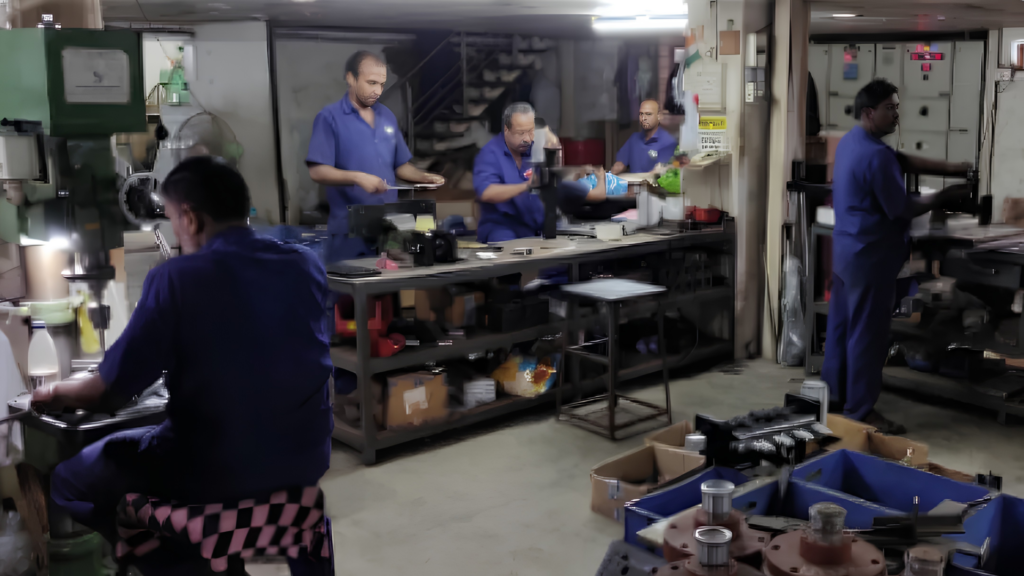
The People Behind Every Machine: Why Our Employees Are the Heart of Global PET Industries Ltd. Category: Company Culture | Manufacturing Excellence When business leaders visit a heavy manufacturing facility, it is natural to admire the structural outcome. They observe the high-speed automation loops, appreciate the pneumatic precision, and map out the capacity outputs. Yet, the true power source remains completely human. Behind every single automated PET blow moulding machine that leaves the loading bays of Global PET Industries Ltd. is a unified assembly of dedicated industrial professionals. This cross-functional family includes design engineers, skilled machinists, structural assemblers, industrial electricians, quality assurance inspectors, and global field service engineers working in harmony daily. Machines build plastic containers, but dedicated people build those machines from the ground up. Manufacturing is a High-Precision Team Sport An elite, high-output blow moulding system cannot be produced through isolated individual efforts. It requires deep collaboration across multiple highly specialized engineering disciplines. When each department maintains alignment, complex technical systems transform seamlessly from blueprint concepts into reliable field equipment. Design & CAD Engineers Translating structural packaging physics into robust mechanical designs optimized for active performance models. Precision Machining Teams Operating advanced tooling centers to manufacture critical steel and alloy sub-components with sub-millimeter accuracy. Pneumatic & Electrical Techs Wiring advanced control systems and routing high-pressure lines to ensure precise, rapid cycle execution. Field Commissioning Experts Traveling globally to integrate machinery setups, calibrate operations on-site, and train client teams for flawless production runs. Every System Represents Thousands of Micro-Decisions While an external purchaser observes a beautifully unified piece of capital hardware, our production specialists see months of strategic planning, structural inspection, and iterative testing. Every electrical terminal checked, every block aligned, every main valve pressure-tested, and every custom mould set calibrated is critical. These continuous small actions form the operational reliability that guards our client brands against unplanned field downtime. 30+ Years Industry Trust 100% In-House Engineering Thousands Daily Quality Checks Technical Expertise and Shop Floor Skillsets Operating a modern industrial engineering platform requires more than just mechanical labor. It demands an environment built around continuous learning, safety standards, and pride in visual and structural craftsmanship. To stay ahead of global industry shifts, our teams continuously update their technical skill sets: Advanced Mechatronics Literacy: Mastery over complex programmable logic controllers (PLCs) and multi-axis servo architectures. Stringent Safety Protocols: Maintaining zero-accident manufacturing floor frameworks across all operations. Advanced Metallurgy & Tolerances: Ensuring structural components resist continuous high-pressure stress cycles without wearing down. Innovation Begins on the Production Floor “Some of our most profound technical improvements do not emerge from isolated boardroom discussions. They are born right on the production floor from the insight of technicians who interface with our machinery daily. A suggestion to improve assembly access, a smarter component routing method, or a more efficient testing loop—these real-world inputs continuously refine our equipment solutions.” Sustained Growth Through Mutual Investment As Global PET Industries Ltd. expands its operational machinery footprint across thriving domestic markets and emerging international economic corridors, our core team remains our primary competitive advantage. We operate on a foundational principle: actively investing in the safety, fulfillment, and technical capabilities of our people directly secures the operational success of our global customers. Our Sincere Message of Appreciation To every design engineer, technical machinist, assembly specialist, electrical tech, quality inspector, field support engineer, and administrative staff member within the Global PET family: Thank you. Your daily commitment and dedication form the baseline of every corporate milestone we achieve. Together, we aren’t just constructing machinery—we are building trust, sustaining client partnerships, and engineering the future of global rigid packaging technology.
Why India’s Next Packaging Billionaires Will Come from PET Manufacturing
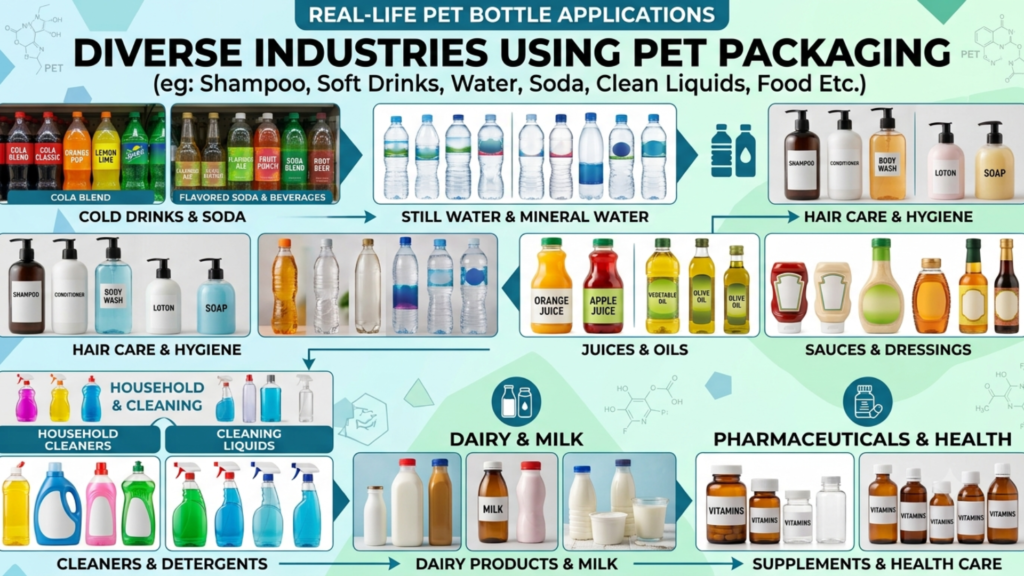
Why India’s Next Packaging Billionaires Will Come from PET Manufacturing Category: Industry Insights • Reading Time: 8 Minutes India is entering a transformative manufacturing era. While standard startup investments flow toward traditional sectors, a quiet revolution is happening inside the PET packaging landscape—and the financial scale is historic. Look around your room right now. The water bottle on your desk, the edible oil in your kitchen pantry, the shampoo in your bathroom, the prescription container in your medicine cabinet, the cosmetic jar, the detergent handle… almost every vital asset of modern daily consumption relies completely on PET (Polyethylene Terephthalate) packaging. Behind every scaling FMCG giant stands a high-capacity packaging manufacturer. And behind every elite packaging manufacturer sits advanced PET blow moulding technology. The next generation of exceptional manufacturing leaders will not just sell bottles—they are building the infrastructure that powers whole domestic and international consumer economies. The Demand Never Stops: An Evergreen Market Unlike seasonal industries that fluctuate with shifting consumer market trends, PET packaging enjoys continuous daily usage. People require clean water, use home care chemicals, and consume packaged food every single day. This constant lifecycle ensures steady demand for packaging production regardless of wider macroeconomic changes. One Manufacturing Engine, Hundreds of Target Markets Instead of relying on a single volatile consumer industry, a modern PET bottle manufacturing setup allows business owners to supply dozens of completely independent growth segments simultaneously: Packaged Drinking Water Carbonated Soft Drinks Fruit Juices & Dairy Premium Edible Oils Pharmaceutical Lines Cosmetics & Personal Care Home Care & Cleaners Industrial Lubricants Agrochemical Packaging Nutraceutical Jars Technology Shift: Moving from Manual Setup to Smart Automation A decade ago, competitive manufacturing success was achieved simply by building larger physical factories. Today, market leadership belongs to those who manufacture smarter. Modern packaging production facilities leverage highly automated machinery networks to optimize turnaround speed and protect operational margins. Legacy Production Formats Heavy reliance on continuous manual oversight Volatile heating controls leading to higher scrap rates Excessive energy consumption footprints Protracted tooling changeover timelines Advanced Automation Formats High-efficiency Servo-driven sub-assemblies Intelligent multi-zone heating optimization Integrated real-time digital workflow tracking Rapid quick-change structural mould integration Energy Efficiency is the Modern Profit Margin In high-volume manufacturing, electrical utility consumption represents one of the largest continuous operating expenses. Implementing machinery equipped with advanced servo-actuated configurations and optimized heating architectures dramatically lowers ongoing energy footprints compared to traditional legacy layouts. Over millions of continuous production cycles, these integrated utility reductions drastically improve bottom-line efficiency—allowing smart manufacturers to outcompete rivals on per-unit pricing models while keeping internal margins healthy. Why Quality Wins the Long-Term Market A poor-quality container carries substantial hidden costs for scaling brands. Unreliable wall thickness, structural weakness, or neck finish errors lead to line stoppages, product leakage during transit, and damage to brand reputation. Because of this, leading consumer enterprises choose long-term stability over the cheapest option. Business operators who achieve consistent quality turn regular buyers into reliable corporate partnerships. Flawless Geometric Clarity: Enhances shelf presence and customer confidence. Structural Weight Optimization: Lowers resin weight costs without weakening structural performance. Perfect Neck Tolerance: Guarantees leak-proof performance on high-speed filling lines. The True Opportunity: Becoming a Packaging Solutions Partner Many new business owners think they are entering the basic container supply trade. In reality, they are entering the comprehensive **packaging solutions enterprise**. Every emerging health brand, beverage startup, or pharmaceutical corporation requires custom structural packaging execution to safeguard their formulations. The operators who position themselves to solve complex design challenges, deliver fast turnarounds, and scale production seamlessly become strategic corporate partners rather than simple commodity vendors. Capitalizing on Global Export Markets The business opportunity is no longer confined within regional borders. Competent manufacturers across India are continuously growing their export footprint—delivering premium finished packaging alternatives directly into expanding industrial zones across Africa, the Middle East, Southeast Asia, Europe, and South America. Partnering with Global PET Industries Ltd. For nearly three decades, Global PET Industries Ltd. has partnered with scaling manufacturers by providing cutting-edge PET blow moulding technology, rigorous engineering expertise, and highly responsive post-installation support. From highly accessible semi-automatic systems for growing businesses to advanced, high-speed fully automatic servo-driven industrial infrastructure, our machine systems are precision-engineered to help you maximize energy efficiency, protect quality parameters, and secure long-term manufacturing value. Ready to Build Your Packaging Empire? The future belongs to manufacturers who back their vision with modern automation, high efficiency, and reliable engineering. Partner with Global PET Industries to implement the technology layout your enterprise needs to lead the market. Connect with an Automation Expert
The ₹1 Crore Mistake: Why Buying the Wrong PET Blow Moulding Machine Can Cost More Than You Think
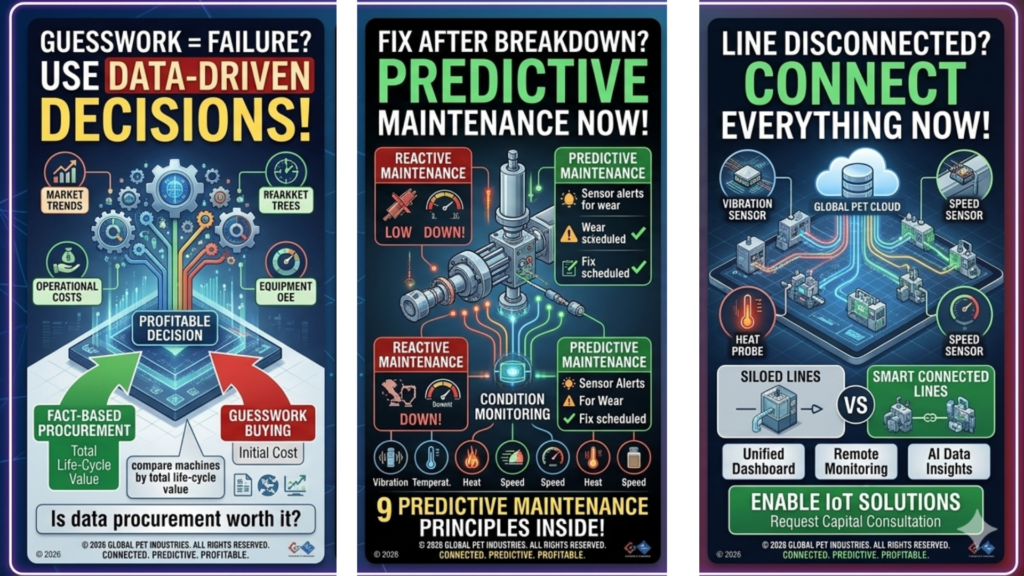
The ₹1 Crore Mistake: Why Buying the Wrong PET Blow Moulding Machine Can Cost More Than You Think Capital Evaluation Report: Beyond the Initial Machinery Purchase Price Total Cost of Ownership (TCO) Model: Premium Engineering vs. Budget Alternatives When manufacturers enter the procurement phase for a new PET stretch blow moulding machine, they frequently make the mistake of evaluating only a single data point—the upfront purchase price. However, experienced plant owners and financial stakeholders recognize that the true cost of an industrial asset is measured over its entire active operational lifespan, not on the day the purchase order is signed. A machine that appears exceptionally cheap on a preliminary quotation can quickly transform into an aggressive capital drain if it introduces frequent line downtime, inconsistent container finishes, high daily power consumption, or constant spare parts requirements. The smartest business investment is rarely the cheapest option; it is the infrastructure that provides unyielding operational performance and predictable long-term profitability. 1. Downtime Costs More Than You Realize In high-speed production environments, machine downtime is a direct hit to your bottom line. Every single hour your primary production line sits idle triggers a severe cascade of financial liabilities across your manufacturing ecosystem: Missed supply deadlines and supply chain penalties Sustained idle labor overheads and factory floor inefficiencies Delayed customer shipments that back up your warehouse logistics Erosion of hard-earned client trust and brand reputation Investing in reliable, precision equipment is the single most effective way manufacturers protect their daily volume commitments and fulfill market demands without interruption. 2. Poor Bottle Quality Increases Waste Substandard thermal heating systems or unstable mechanical mould alignments inevitably compromise production consistency. This technical variance manifests as costly defects: The Cost of Quality Failures Inconsistent wall thickness, high container rejection rates, material waste, and visible cosmetic flaws quickly consume raw PET resin margins. Achieving predictable bottle quality is an absolute necessity to prevent material loss and maintain market authority. 3. Energy Efficiency Matters Every Day Unlike fixed asset procurement costs, electricity consumption is an active, recurring operational expense that impacts your profit margins every day. Modern blow moulding systems designed with advanced infrared heating zones, optimized servo motion profiles, and intelligent pneumatic recycling systems systematically reduce utility bills month after month compared to older, unregulated technology formats. 4. Maintenance Should Not Interrupt Production Frequent component failures and unnecessarily complex maintenance schedules drag down your overall equipment effectiveness (OEE). Choosing a well-engineered machine structured with high-grade components and backed by reliable technical support prevents unexpected stoppages, keeping your operation moving at maximum capacity. 5. Flexibility Creates New Business Opportunities Market requirements shift rapidly, and agile facilities excel. True asset value lies in your machinery’s capability to adapt cleanly to diverse container types across multiple packaging sectors: Packaged Water Edible Oils Pharmaceuticals Household Goods Personal Care Wide-Mouth Jars This cross-industry versatility ensures constant machine utilization, allowing your business to pivot into high-margin segments easily. 6. Technical Support Is Part of the Investment Even the highest-grade mechanical hardware requires professional handling during system installation, calibration, and routine adjustments. Partnering with an engineering-focused supplier with an active, fast-response after-sales organization directly limits operational risk and secures stable output patterns. 7. Return on Investment Matters More Than Purchase Price When you shift your perspective from initial cost to long-term profitability, high-performance machinery establishes its clear financial dominance: The High-Yield ROI Blueprint A highly reliable, automated production asset consistently delivers stronger financial returns by locking in: Unwavering, stable production uptime Perfect, repeatable container finishes Minimized preform material waste Reduced maintenance and utility overheads Final Thoughts The optimal machine configuration for your plant is never determined by a low initial price tag. It is determined by its long-term capacity to help your enterprise manufacture efficiently, satisfy client demands, and maintain high profit margins year after year. For manufacturers projecting long-term growth, prioritizing engineering excellence and technological stability is one of the safest and most profitable business decisions they can make. Hidden Capital Drains The factors that turn cheap hardware into a major financial loss: High-pressure air leaks Erratic preform thermal tracking Frequent cylinder seal wear Slow changeover delays Audit Your Line’s Efficiency Don’t let hidden operating costs quietly drain your profitability. Connect with our engineering consulting team to map your production line’s actual total cost of ownership (TCO). Request Capital Consultation © 2026 Global Pet Industries Limited | Precision Engineering. Protected Investments.
The PET Industry Will Look Very Different in 5 Years. Here’s Why
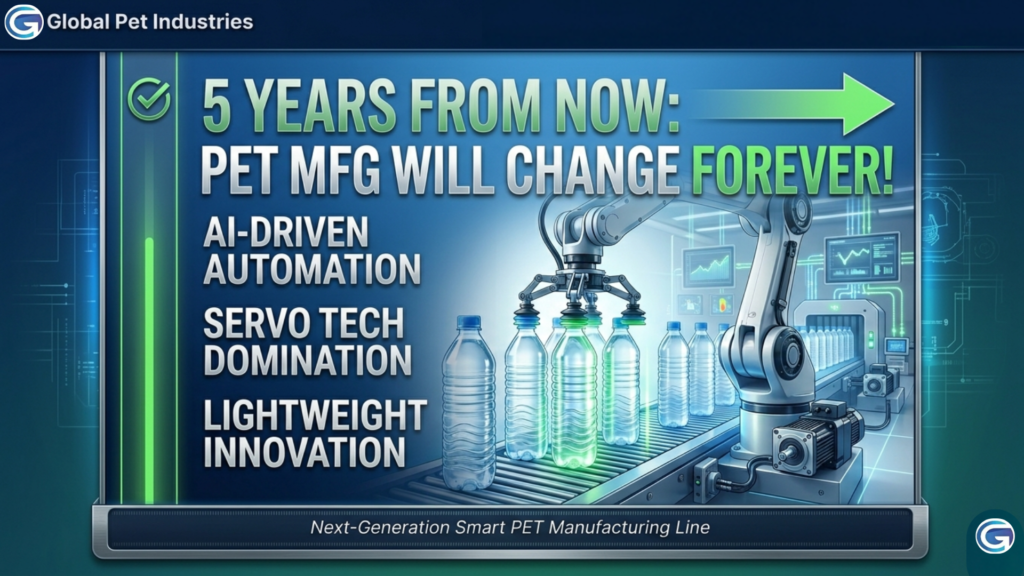
The PET Industry Will Look Very Different in 5 Years. Here’s Why Future Trends That Will Redefine PET Bottle Manufacturing Industry 4.0 Integration: Automated, Servo-Driven Production Architectures The PET packaging industry has experienced remarkable growth over the past two decades. From bottled water and beverages to pharmaceuticals, edible oils, personal care products, and industrial packaging, PET containers have become an essential part of modern global infrastructure. However, the next five years are poised to bring more radical disruption than the previous twenty combined. While the majority of manufacturing facilities remain single-mindedly focused on scaling basic production capacity, forward-thinking industry leaders are preparing for an entirely different operational paradigm. The future of manufacturing belongs to plants built around deep automation, intelligence, resource efficiency, and sustainability. The fundamental question is no longer “Can we produce more?” but rather, “Can we produce smarter?” 1. Automation Will Become the Industry Standard Manufacturing facilities worldwide are rapidly moving toward fully automated production environments. Tasks that once required multiple floor operators are increasingly being streamlined through smart handling systems, reducing manual human intervention while drastically improving batch consistency and hourly productivity. Higher overall production efficiency Drastic reduction in manual operational errors Improved and repeatable container quality Lower manual manpower dependencies Predictive and precise production planning capabilities The manufacturing plants of tomorrow must rely heavily on automated systems simply to remain competitive in a margin-sensitive landscape. 2. Servo Technology Will Dominate Manufacturing Traditional pneumatic and hydraulic machine setups are gradually being phased out in favor of pure servo-driven technology. Servo systems provide precise mechanical control, excellent cycle repeatability, lightning-fast response times, significantly lower energy profiles, and minimized mechanical component wear. As operators pursue absolute cost optimization, servo technology is setting the standard across the PET industry. 3. Lightweight Packaging Will Drive Innovation Global brands are under constant pressure to minimize material consumption without compromising structural container safety or clarity. This challenge has driven a major surge in demand for lightweight PET bottle designs, optimized preform material distribution, and advanced engineering configurations. Facilities capable of outputting lightweight shapes with high structural integrity will maintain a profound competitive advantage. 4. Faster Mould Change Systems Will Become Essential Line downtime remains the single largest hidden cost in modern manufacturing. Every minute lost during a mould change directly degrades overall equipment effectiveness (OEE). Modern plants now expect rapid, quick-change mould setups, modular machine layouts, and minimized transition windows to handle dynamic, multi-product production demands with high agility. 5. Industry 4.0 and Smart Manufacturing Are Arriving Production hardware is transforming from isolated, standalone equipment into highly connected, intelligent production ecosystems. Next-generation systems deliver real-time operational monitoring, predictive maintenance tracking, continuous analytics, and remote diagnostics. These digital frameworks allow plant managers to make faster, data-driven operational decisions. 6. Energy Efficiency Will Become a Competitive Advantage Volatile energy costs continue to present a critical challenge to manufacturing plants worldwide. Future capital procurement decisions will pivot strictly around energy mitigation: lower kilowatt-hour power draws, optimized high-pressure air consumption, intelligent heating zones, and eco-saving standby configurations. Energy optimization has shifted from a corporate compliance metric into a hard business necessity. 7. Sustainability Will Shape Future Packaging Regulators, consumer groups, and multinational consumer brands are placing intense emphasis on ecological lifecycles. The market will reward highly recyclable container designs, resource-efficient production equipment, and closed-loop circular economy operations. Early technological adopters will be perfectly positioned to capture this shifting market demand. What This Means for Manufacturers The upcoming five-year window will divide the manufacturing landscape into two distinct corporate trajectories: Companies That Adapt Purposefully invest in modern technology Maximize daily production efficiency Systematically lower variable operating costs Sustain strong long-term profitability Cement their global market competitiveness Companies That Resist Change Struggle against escalating production costs Suffer from degraded line efficiencies Face aggressive market competitive pressures Experience shrinking net profitability margins The Global PET Perspective At Global PET Industries Limited, we believe the future belongs exclusively to manufacturers who embrace structural innovation and continuous mechanical optimization. Our engineering focus remains anchored in developing advanced PET blow moulding designs that support total automation, precise servo technology, state-of-the-art mould setups, and absolute energy efficiency. As the global landscape evolves, our core objective remains unchanged: equipping manufacturing enterprises with the smarter, faster, and more competitive production assets required for tomorrow. Conclusion The future of PET manufacturing is not a simple race to produce a higher volume of containers. It is an evolution toward smarter, faster, more resource-efficient, and structurally sustainable production execution. The enterprises that step forward and invest in industrial transformation today will emerge as the definitive market leaders of tomorrow. The transformation is already underway—the only question left is: Is your factory ready? 5-Year Roadmap Indicators Key focus areas for smart factory upgrades: Real-time OEE Analytics Advanced Servo Precision Eco-Design Optimization Zero-Downtime Mould Swaps Future-Proof Your Plant Consult with our automation and servo design engineers to evaluate how your line can transition into an efficient, smart manufacturing setup. Connect With Our Team © 2026 Global Pet Industries Limited | Smarter Engineering. Future-Ready Solutions.
Customer Bought a Cheaper Machine First… Then Switched to Global PET. Here’s What Happened.
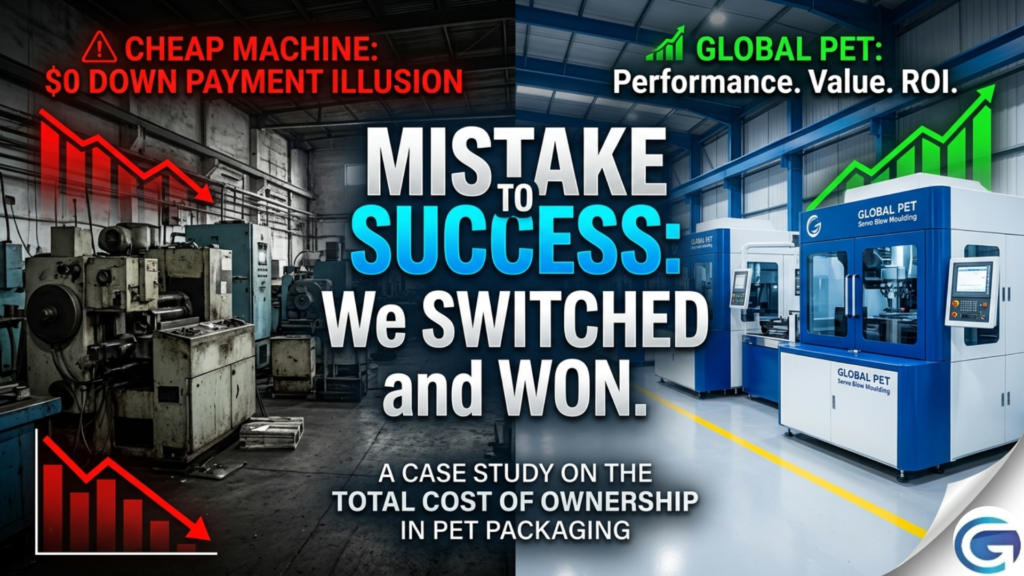
Customer Bought a Cheaper Machine First… Then Switched to Global PET. Here’s What Happened. A Comprehensive Analysis of Total Cost of Ownership (TCO) in PET Packaging Production Operational Efficiency Assessment: Upgrading to High-Performance Servo Blow Moulding Systems In the highly competitive PET packaging industry, the initial purchase price of machinery often attracts the most attention during the procurement phase. However, seasoned manufacturers recognize that the true cost of ownership is never determined on day one. It is systematically calculated over time through daily machine performance, production efficiency metrics, unplanned maintenance frequencies, bottle output quality, and long-term mechanical reliability. This case study details the journey of an industrial packaging producer who chose to evaluate these variables firsthand, demonstrating how short-term capital savings can dramatically impact long-term operational profitability. The Initial Investment: The Illusion of Low-Cost Savings Seeking to optimize their initial capital layout, one of our clients originally invested in a lower-cost alternative stretch blow moulding machine. The upfront capital expenditure was significantly lower than premium industry baselines, promising rapid initial savings and a superficial reduction in startup overheads. However, once the production line entered continuous operation, serious systemic challenges quickly materialized across their manufacturing environment: Phase 1: Mechanical Instability & Power Surge The low-cost system suffered from unstable preform heating and high air consumption patterns, causing a sharp spike in monthly utility expenses. Phase 2: Escalating Maintenance & Downtime Frequent structural breakdowns led to unscheduled production interruptions, elevated spare component expenses, and high rejection rates that directly eroded customer delivery timelines. Instead of scaling output, the manufacturing facility entered an expensive loop of reactive troubleshooting, where thin machine profit margins were consistently consumed by operational downtime losses and material waste. The Turnaround: Upgrading to Global PET Infrastructure Recognizing the unsustainable trajectory of their production margins, the customer conducted a complete audit of their total cost of ownership. The decision was made to retire the low-cost asset and upgrade their line with advanced Global PET machinery. The transition provided an immediate, quantifiable shift in every major production benchmark: ✓ Consistent Bottle Quality ✓ Improved Production Efficiency ✓ Radiantly Reduced Downtime ✓ Minimal Maintenance Requirements ✓ Advanced Energy Efficiency ✓ Accelerated Return on Investment (ROI) Today, this client operates their production lines with complete operational confidence, achieving significantly higher output yields and meeting stringent packaging quality requirements without variance. The lesson is simple: The cheapest machine is rarely the most economical investment. In high-output manufacturing, real capital value is built exclusively through engineering reliability, systemic design quality, immediate service support, and extended long-term performance. Conclusion: Measuring Value by Concrete Results At Global PET Industries Limited, our engineering focus remains fixed on helping manufacturers build sustainable, highly profitable operations. Our advanced PET blow moulding systems are structurally engineered from the ground up to prioritize performance, thermal efficiency, and long-term mechanical reliability. Smart, industrial investments are evaluated by ongoing line results, not just the initial purchase price. Partner with Global PET to ensure your production infrastructure is engineered for the long-term success your enterprise deserves. Financial Metrics Analysed Key areas where the cheap machine lost profitability: Preform material rejection rate Unscheduled component wear Peak-load energy draw Idle labor overheads Calculate Your True TCO Let our engineering team assist you in mapping out your operational expenses to find out how much a high-efficiency servo upgrade can save your plant. Request ROI Analysis © 2026 Global Pet Industries Limited | Performance Engineered. Value Delivered.
Why Indian Manufacturing Struggles While Chinese Machine Companies Dominate the Global Market
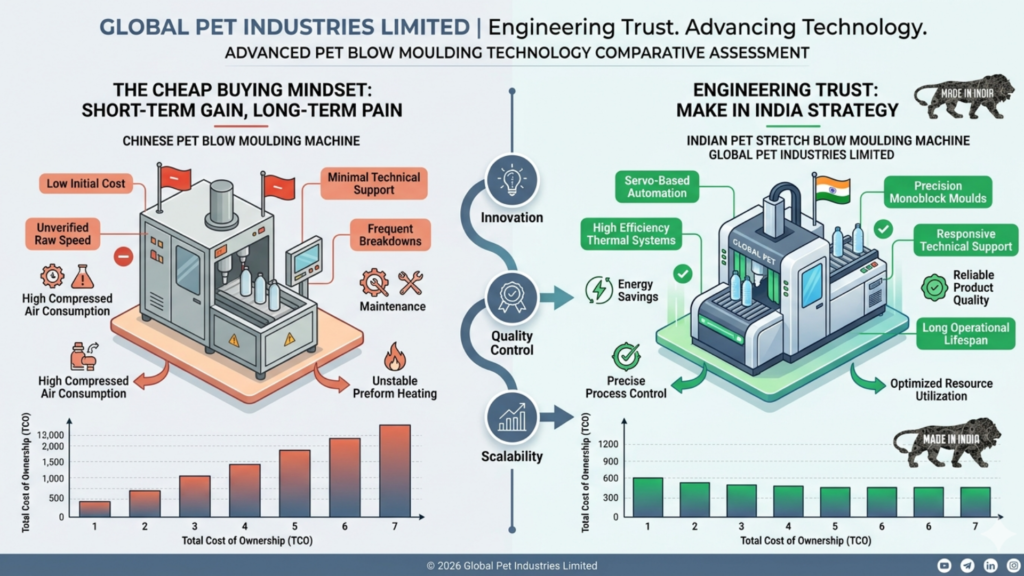
Why Indian Manufacturing Struggles While Chinese Machine Companies Dominate the Global Market The Real Truth About Cost, Quality, Speed & the “Make in India” Challenge Comparative Industrial Assessment: Global Machinery Deployment Factors India currently maintains one of the world’s fastest-growing manufacturing sectors. The nation is backed by highly skilled engineers, resilient entrepreneurs, and an expansive domestic market. Despite these immense native advantages, a significant cross-section of modern industries still depends heavily on imported machinery—particularly options sourced from China. This reality prompts critical operational questions: Why does this systemic dependence persist? Why do Chinese machine manufacturers continue to expand their global market share despite ongoing industrial complaints regarding machine life, after-sales support, and structural quality issues? Most importantly, can Indian manufacturers build global-level machinery brands capable of shifting this dynamic? The answer is definitively yes. However, this transformation can only occur if the domestic industry accurately understands the systemic and psychological challenges behind long-term industrial growth. The Core Obstacle: The “Cheap Buying Mindset” The primary barrier to accelerating domestic manufacturing quality is a widespread purchasing philosophy that prioritizes short-term capital expenditures over total cost of ownership (TCO). Many buyers evaluate capital machinery using a limited set of immediate metrics: The Short-Term Focus Purchasing choices driven primarily by: Initial purchase price considerations Unverified raw speed claims Immediate delivery timelines The Real Capital Impact Critical long-term variables frequently ignored: Long-term structural maintenance costs Daily operational energy consumption Total machine operational lifespan Production cycle stability and spare availability This dynamic creates a highly restrictive operational loop: purchasing low-cost machinery leads to frequent component breakdowns, resulting in inconsistent production outputs, depleted margins, and an inability to fund industrial expansion. Conversely, global market leaders anchor their operations around engineering precision, deep automation, long-term operational reliability, systematic energy savings, and consistent product quality. This alternative focus is how industrial enterprises scale sustainably. Decoding the Accelerated Growth of External Competitors It is an industrial misconception that international competitor dominance was achieved solely through low pricing. The rapid scaling of these machinery networks relies on four structural pillars: Massive Integrated Supply Ecosystems: Manufacturing hubs ensure localized, immediate availability of electronics, high-grade servo systems, fabrication facilities, automation components, precision tooling, and heavy casting. This density lowers production costs and accelerates time-to-market. Aggressive Global Export Strategies: Early international market entries were backed by massive production capacities, volume manufacturing capabilities, fast supply turnarounds, and highly competitive entry-level pricing structures. Targeted Institutional Manufacturing Support: Manufacturing enterprises benefited directly from robust industrial infrastructure, dedicated manufacturing zones, structural export incentives, and streamlined administrative approval processes. Continuous Technology Upgradation Cycles: Small and mid-sized enterprises consistently re-invested capital into engineering upgrades, integrating advanced servo technologies, robotics, automation systems, and high-precision tooling. The Long-Term Capital Realities While low-cost imported machinery configurations often look financially viable on a preliminary balance sheet, they frequently introduce severe hidden operational costs over time. Industrial operators routinely face high compressed air consumption, unstable preform heating dynamics, highly inconsistent bottle finishes, elevated component rejection rates, an increased reliance on manual intervention, minimal technical support networks, and severely shortened equipment lifespans. Over a standard 5-to-7-year operational lifecycle, the cumulative financial drain of unexpected downtime, wasted raw materials, and high energy utilization far outweighs the initial acquisition savings. Elevating the Mandate for “Make in India” The “Make in India” initiative extends far beyond simple geographic manufacturing. It represents a fundamental shift toward establishing deep engineering confidence, innovating proprietary global technologies, reducing structural import dependencies, sustaining local technical employment, and building resilient industrial supply bases. India is fully positioned to evolve into a primary global machinery hub, provided manufacturing facilities realign their strategic focus around continuous innovation, strict quality control, precision engineering execution, deep automation integration, and long-term capital horizons. Five Strategic Pillars for Global-Scale Growth To successfully compete with global engineering giants, domestic machinery manufacturers must execute five core transitions: Prioritize High Engineering Execution over Price: Long-term market share is consistently won through technical performance and process control. Capitalize on Modern Automation: Future profitability relies on integrating precision servo systems, advanced robotics, high-efficiency moulding, and optimized energy management frameworks. Establish Highly Responsive Technical Support: Long-term client retention is anchored by technical support organizations that eliminate unscheduled downtime. Advance Internal Manufacturing Standards: Precision production execution directly results in superior container clarity, lower rejection rates, reduced component wear, and elevated client trust. Adopt Extended Strategic Horizons: Lasting industrial brands are built systematically over time through consistency, technological innovation, and reliable engineering execution. Global PET’s Vision Since 1996, Global PET Industries Limited has systematically dedicated its engineering resources to pioneering advanced PET stretch blow moulding technologies. Our focus centers on integrating servo-based automation, designing energy-efficient thermal systems, manufacturing precision monoblock moulds, and delivering complete, turn-key PET packaging solutions. Our ultimate objective goes far beyond basic machine assembly; we are actively invested in engineering a highly competitive, technologically advanced, and self-reliant domestic manufacturing ecosystem. Conclusion The necessary engineering talent, domestic market scale, and design capabilities are completely present within the region. The path forward demands an unyielding confidence in domestic manufacturing capabilities, purposeful capital investment into advanced machinery platforms, and a commitment to long-term industrial planning. The future belongs decisively to enterprises that innovate rather than those that compete solely on baseline cost. Core Comparative Metrics Industrial performance factors examined in this report: Total Cost of Ownership (TCO) Thermal Reheating Stability Precision Servo Efficiency Monoblock Alignment Life Engineering Consulting Evaluate your production line’s long-term energy and material efficiency metrics with our technical design team. Contact Engineering Team © 2026 Global Pet Industries Limited | Engineering Trust. Advancing Technology.
The Evolution of PET Blowing in India
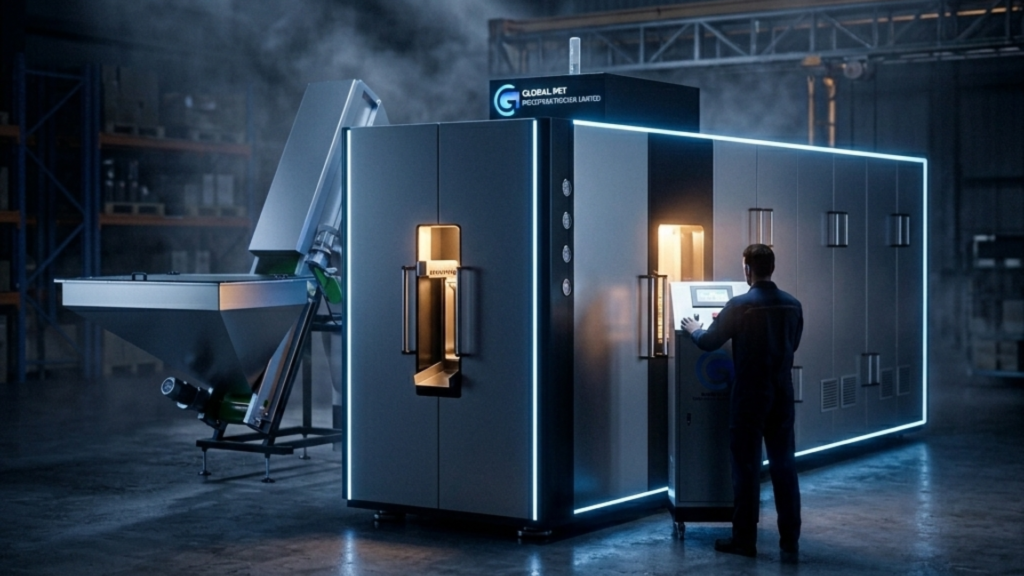
The Evolution of PET Blowing in India Special Anniversary Feature Mapping the 30-year journey from glass to high-speed polymer precision—and the role of Global Pet Industries in shaping the nation’s packaging future. Historical Context The Rise of a Packaging Giant The PET (Polyethylene Terephthalate) revolution in India began as a necessity. As the nation’s demand for safe, lightweight, and recyclable packaging surged—spanning across packaged water, beverages, edible oils, and pharmaceuticals—the industry underwent a radical transformation from fragile glass to durable polymer technology. The Import Era(Pre-1990s) A period defined by high entry barriers, where machines were imported, technology was restricted, and production costs remained inaccessible for SME manufacturers. The Indigenization(Late 1990s – 2010) The pivotal shift where Indian engineering began replacing imports. Global Pet Industries emerged as a key catalyst, delivering semi-automatic and reliable two-stage blowing systems. The Servo Revolution(2020 – Present) The modern era of high-speed automation, robotic integration, and Industry 4.0 energy efficiency, where Indian machines now lead global export markets. Technological Mastery Engineering the Future Global Pet Industries Limited has not just witnessed this evolution—we have engineered it. Since 1996, we have transitioned from fundamental blow moulding to fully automatic servo-driven systems that define modern production efficiency. ✔ 99.9% Production Reliability ✔ Advanced Energy-Efficient Infrared Heating ✔ Global Footprint in Over 20+ Countries 30+ Years of Pedigree 100% Recyclable Solutions NSE SME Listed Entity High Speed Automation Final Insight Driving Industrial Growth The PET industry is no longer just about packaging—it is the backbone of the FMCG and Pharmaceutical sectors. As we look toward a future of Smart Manufacturing and Sustainability, Global Pet Industries Limited remains committed to delivering the excellence that fuels India’s industrial rise. Mr. Bipin Nanubhai Panchal Promoter Chairman and Managing Director GLOBAL PET INDUSTRIES LIMITED CRAFTING THE FUTURE OF PACKAGING | NSE LISTED
Focusing on “cheap” technology is an expensive mistake.
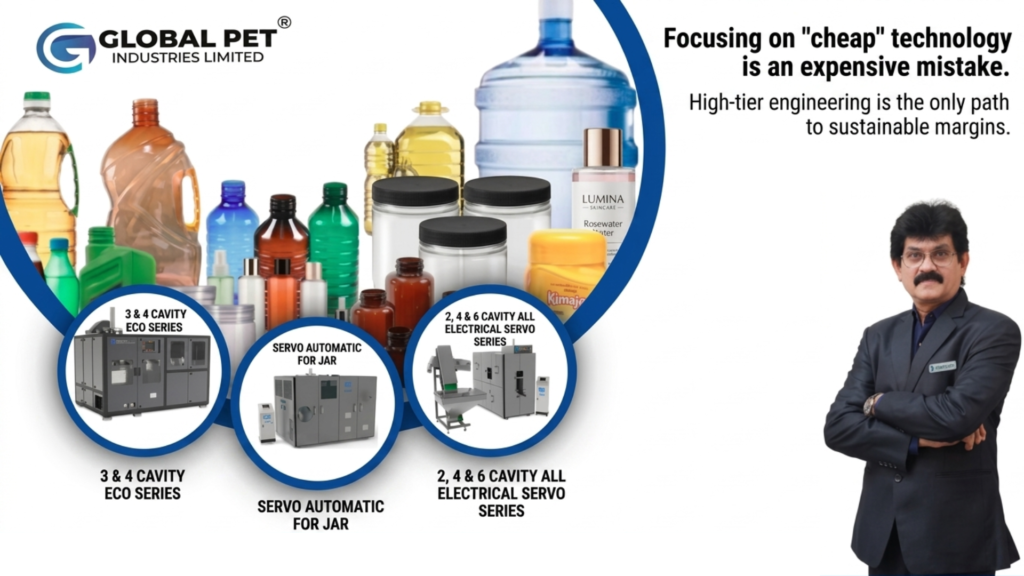
Focusing on “cheap” technology is an expensive mistake. High – tier engineering is the only path to sustainable margins. Fiscal Strategic Briefing Uncovering the systemic operational inefficiencies that erode profitability in the PET packaging ecosystem. In the competitive landscape of industrial manufacturing, focusing solely on the acquisition cost of machinery is a strategic oversight. True profitability is defined by the Total Cost of Ownership (TCO). At Global Pet Industries Limited, leveraging our 30-year engineering pedigree, we have identified the primary “Hidden Opex” vectors that silently degrade the financial health of manufacturing enterprises. Exposure Vector 01 Systemic Power Inefficiency Low-tier heating systems lack thermal regulation, leading to excessive energy draw. Over a 5-year cycle, the electricity cost delta between a standard and an energy-efficient machine can exceed the initial purchase price. Exposure Vector 02 Material Attrition & Rejection Inconsistent thermal profiles result in high rejection rates. Every failed unit represents wasted resin, lost production time, and a direct reduction in net yield. Exposure Vector 03 Operational Stagnation (Downtime) Unplanned breakdowns are not merely repair costs; they are “Opportunity Costs” that damage client trust and disrupt global supply chain commitments. Exposure Vector 04 Manual Labor Liability High dependency on manual intervention increases payroll overhead and the statistical probability of human error, preventing the precision required for pharma-grade output. Exposure Vector 05 Mould Life Degradation Substandard mould metallurgy leads to uneven thickness and premature wear, forcing frequent, unplanned capital reinvestment. Exposure Vector 06 Technical Support Vacuum A lack of rapid, expert-level technical response turns minor mechanical issues into catastrophic production halts. “Profit is not determined by the price of entry, but by the efficiency of the lifecycle.” Focusing on “cheap” technology is an expensive mistake. High-tier engineering is the only path to sustainable margins. The Architecture of Profitability Advanced Servo-Driven Production Lines High-Efficiency Infrared Heating Modules Precision-Engineered Multi-Cavity Moulds Scalable, Automated Manufacturing Workflows 24/7 Technical Consultation Ecosystem NSE-Listed Transparency & Reliability Mr. Bipin Nanubhai Panchal Promoter Chairman and Managing Director Global Pet Industries Limited 30 YEARS OF ENGINEERING EXCELLENCE | NSE SME LISTED ENTITY