
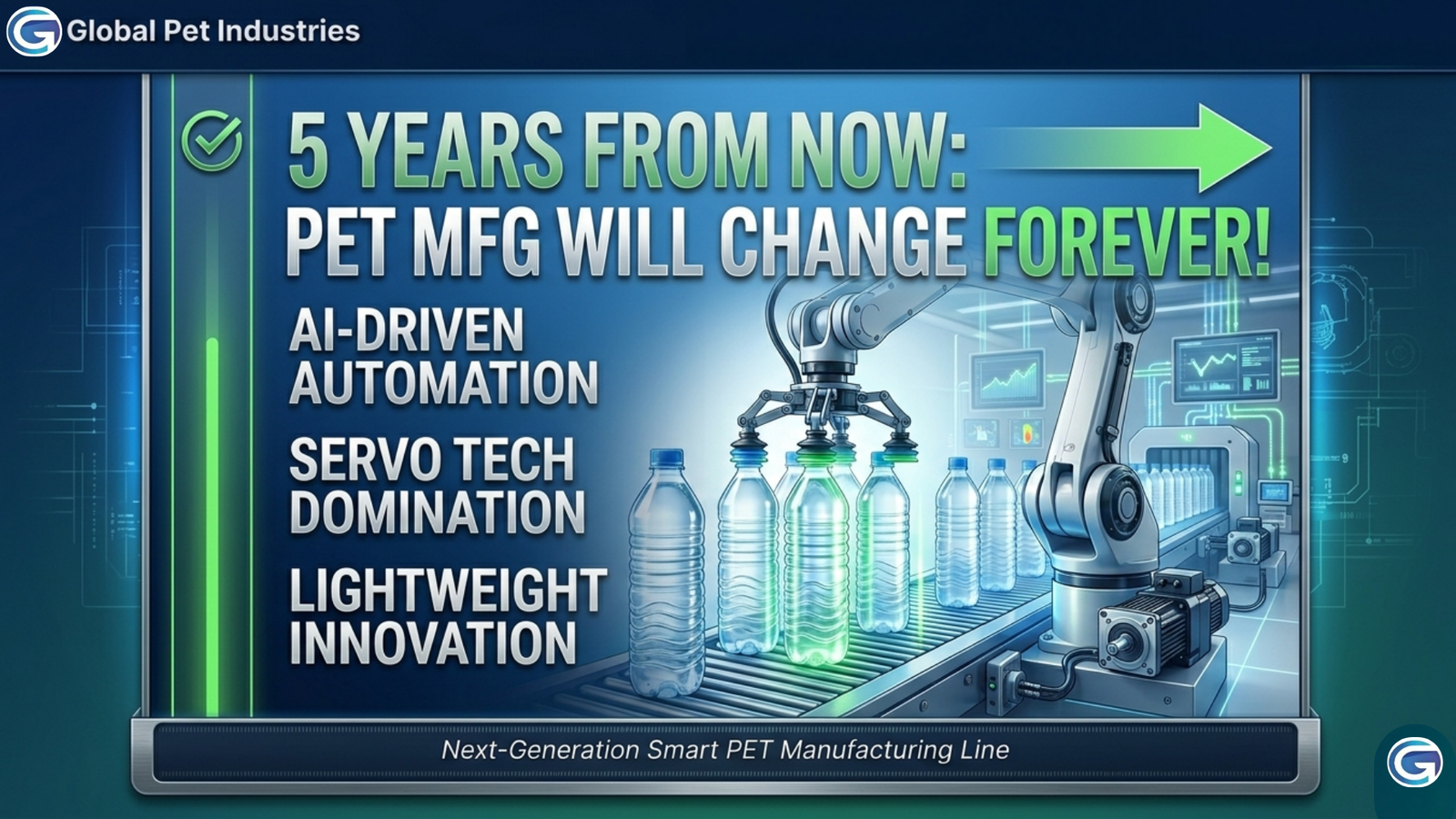
Industry 4.0 Integration: Automated, Servo-Driven Production Architectures
The PET packaging industry has experienced remarkable growth over the past two decades. From bottled water and beverages to pharmaceuticals, edible oils, personal care products, and industrial packaging, PET containers have become an essential part of modern global infrastructure. However, the next five years are poised to bring more radical disruption than the previous twenty combined.
While the majority of manufacturing facilities remain single-mindedly focused on scaling basic production capacity, forward-thinking industry leaders are preparing for an entirely different operational paradigm. The future of manufacturing belongs to plants built around deep automation, intelligence, resource efficiency, and sustainability. The fundamental question is no longer "Can we produce more?" but rather, "Can we produce smarter?"
1. Automation Will Become the Industry Standard
Manufacturing facilities worldwide are rapidly moving toward fully automated production environments. Tasks that once required multiple floor operators are increasingly being streamlined through smart handling systems, reducing manual human intervention while drastically improving batch consistency and hourly productivity.
- Higher overall production efficiency
- Drastic reduction in manual operational errors
- Improved and repeatable container quality
- Lower manual manpower dependencies
- Predictive and precise production planning capabilities
The manufacturing plants of tomorrow must rely heavily on automated systems simply to remain competitive in a margin-sensitive landscape.
2. Servo Technology Will Dominate Manufacturing
Traditional pneumatic and hydraulic machine setups are gradually being phased out in favor of pure servo-driven technology. Servo systems provide precise mechanical control, excellent cycle repeatability, lightning-fast response times, significantly lower energy profiles, and minimized mechanical component wear. As operators pursue absolute cost optimization, servo technology is setting the standard across the PET industry.
3. Lightweight Packaging Will Drive Innovation
Global brands are under constant pressure to minimize material consumption without compromising structural container safety or clarity. This challenge has driven a major surge in demand for lightweight PET bottle designs, optimized preform material distribution, and advanced engineering configurations. Facilities capable of outputting lightweight shapes with high structural integrity will maintain a profound competitive advantage.
4. Faster Mould Change Systems Will Become Essential
Line downtime remains the single largest hidden cost in modern manufacturing. Every minute lost during a mould change directly degrades overall equipment effectiveness (OEE). Modern plants now expect rapid, quick-change mould setups, modular machine layouts, and minimized transition windows to handle dynamic, multi-product production demands with high agility.
5. Industry 4.0 and Smart Manufacturing Are Arriving
Production hardware is transforming from isolated, standalone equipment into highly connected, intelligent production ecosystems. Next-generation systems deliver real-time operational monitoring, predictive maintenance tracking, continuous analytics, and remote diagnostics. These digital frameworks allow plant managers to make faster, data-driven operational decisions.
6. Energy Efficiency Will Become a Competitive Advantage
Volatile energy costs continue to present a critical challenge to manufacturing plants worldwide. Future capital procurement decisions will pivot strictly around energy mitigation: lower kilowatt-hour power draws, optimized high-pressure air consumption, intelligent heating zones, and eco-saving standby configurations. Energy optimization has shifted from a corporate compliance metric into a hard business necessity.
7. Sustainability Will Shape Future Packaging
Regulators, consumer groups, and multinational consumer brands are placing intense emphasis on ecological lifecycles. The market will reward highly recyclable container designs, resource-efficient production equipment, and closed-loop circular economy operations. Early technological adopters will be perfectly positioned to capture this shifting market demand.
What This Means for Manufacturers
The upcoming five-year window will divide the manufacturing landscape into two distinct corporate trajectories:
Companies That Adapt
- Purposefully invest in modern technology
- Maximize daily production efficiency
- Systematically lower variable operating costs
- Sustain strong long-term profitability
- Cement their global market competitiveness
Companies That Resist Change
- Struggle against escalating production costs
- Suffer from degraded line efficiencies
- Face aggressive market competitive pressures
- Experience shrinking net profitability margins
The Global PET Perspective
At Global PET Industries Limited, we believe the future belongs exclusively to manufacturers who embrace structural innovation and continuous mechanical optimization. Our engineering focus remains anchored in developing advanced PET blow moulding designs that support total automation, precise servo technology, state-of-the-art mould setups, and absolute energy efficiency.
As the global landscape evolves, our core objective remains unchanged: equipping manufacturing enterprises with the smarter, faster, and more competitive production assets required for tomorrow.
Conclusion
The future of PET manufacturing is not a simple race to produce a higher volume of containers. It is an evolution toward smarter, faster, more resource-efficient, and structurally sustainable production execution. The enterprises that step forward and invest in industrial transformation today will emerge as the definitive market leaders of tomorrow. The transformation is already underway—the only question left is: Is your factory ready?