
A PET bottle that tears or bursts during high-pressure blowing represents a major operational failure. It directly erodes factory margins, drives up rejection rates, and leads to costly downtime on high-speed filling lines.
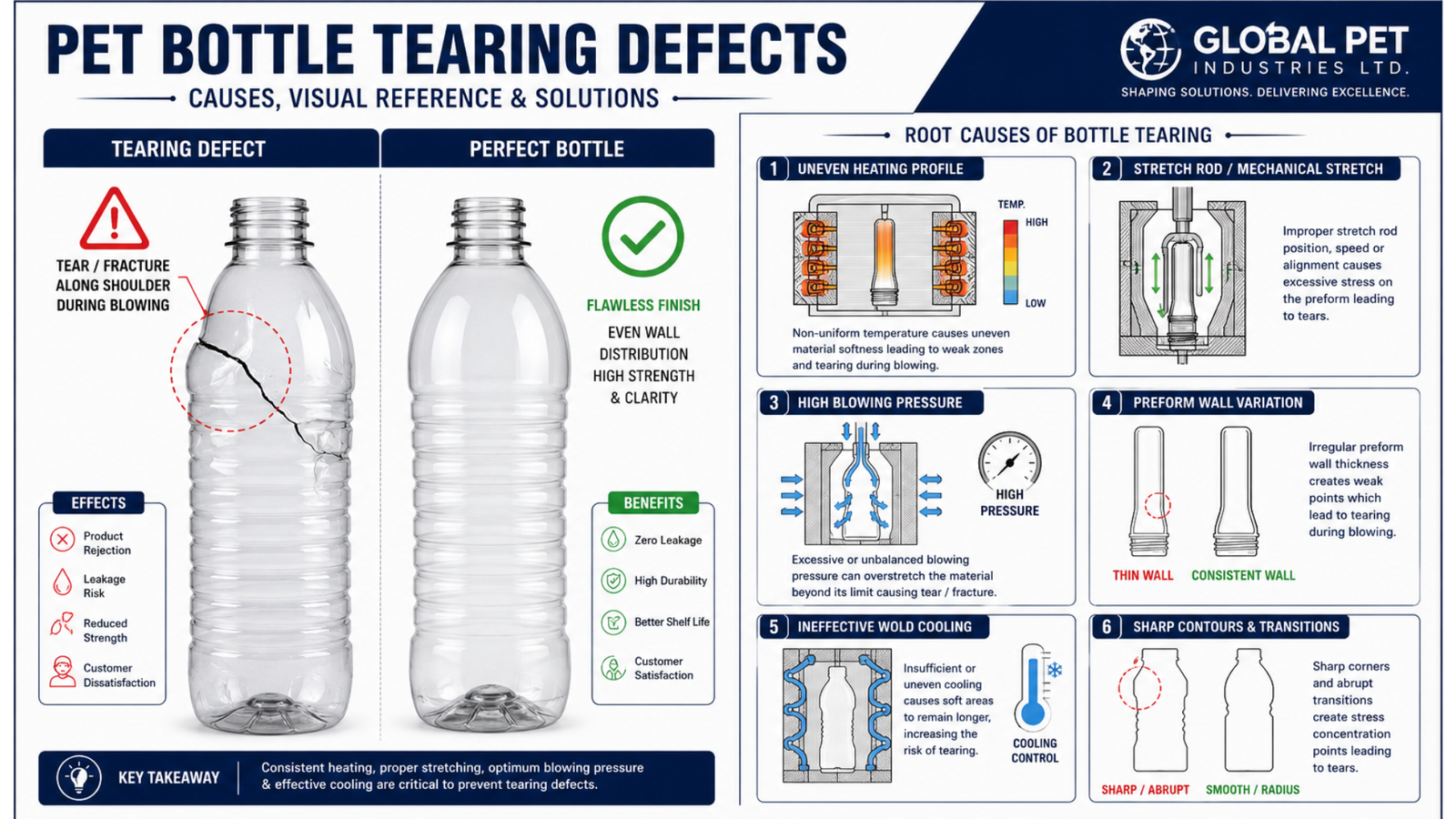
When bottle tearing occurs, plant operators often assume the blow moulding machine is at fault. However, bottle tearing is rarely caused by a single mechanical glitch. It is usually the result of multiple compounding variables—including preform quality, oven heating profiles, bi-axial stretch ratios, air pressure timing, mould cooling channels, and overall process parameters.
Understanding the root cause behind bottle tearing is essential for eliminating scrap, maximizing material efficiency, and securing smooth production runs.
The True Operational Impact of Structural Tearing
A single torn bottle disrupts the entire line cycle. In automated plants, high scrap rates trigger a ripple effect of hidden financial losses across operations:
What Does Bottle Tearing Mean?
Bottle tearing occurs when the PET material ruptures under high-pressure expansion during stretching and blowing. The rupture location provides clear diagnostic clues about process conditions inside the mould:
Every tear reveals specific mechanical or thermal imbalances happening during expansion. Below are the 7 primary root causes of bottle tearing and the exact engineering steps needed to solve them.
01. Uneven Preform Heating
Inconsistent thermal conditioning across the preform body is one of the leading causes of bottle rupture. When one side of a preform absorbs more infrared heat than another, it stretches faster during pre-blow, creating localized thin spots that burst under final high-pressure blowing.
- Bottles tear repeatedly on the exact same side
- Severe wall thickness variation across quadrants
- Visible white stress marks (stress whitening) prior to rupture
- Optimize infrared lamp power settings per heating zone
- Check reflector alignment to ensure heat focus
- Verify smooth preform rotation inside the oven chain
- Monitor ambient temperature and oven ventilation stability
02. Overstretching the Material
Lightweighting reduces resin costs, but pushing preforms beyond their natural stretch limits leads to severe wall thinning and material breakdown, significantly reducing tear resistance.
- Exceeding natural bi-axial stretch limits
- Excessive thinning across high-expansion bottle zones
- Degraded molecular orientation and structural integrity
- Maintain balanced longitudinal and hoop stretch ratios
- Select an optimal preform weight and length for the container size
- Run finite element stress analyses before final lightweighting
03. Poor Preform Quality
Even advanced blow moulding machinery cannot correct defective raw preforms. Inconsistent preform injection leads to inherent structural micro-cracks that fail under high pressure during blowing.
- Moisture absorption due to inadequate drying before injection
- Weight and wall thickness variation between preform lots
- Crystallized or damaged gate areas
- Thermal degradation during injection moulding
- Source preforms from certified, high-precision manufacturers
- Audit incoming preform batches for weight and gate consistency
- Ensure preforms are stored in temperature-controlled environments
04. Excessive Blowing Pressure
Increasing air pressure does not resolve underlying structural defects. Applying maximum pressure too early in the cycle over-stresses warm PET material, causing sudden ruptures.
- Excessive pre-blow pressure forcing rapid, uncontrolled expansion
- Immediate high-pressure blast tearing thin sidewalls
- Severe stress concentrations around sharp geometry transitions
- Precisely adjust pre-blow air pressure and timing sequences
- Calibrate final high-pressure timing based on bottle wall profile
- Maintain recipe parameters specific to container geometry
05. Incorrect Stretch Rod Timing
The mechanical stretch rod guides preforms along the center axis prior to high-pressure air entry. Misaligned or uncalibrated stretch rod movement creates uneven wall distribution and weak points that tear during blowing.
- Synchronize Stretch Rod Timing: Align stretch rod movement with pre-blow air initiation.
- Audit Servo Settings: Ensure linear stretch speed matches preform stretch characteristics.
- Inspect Mechanical Centering: Verify stretch rods enter preforms along a straight center axis.
06. Sharp Bottle Design Features
Complex container features like deep handgrips, sharp structural ribs, or aggressive base contours force PET material to stretch thin across sharp angles, creating localized stress points that rupture during expansion.
- Optimize Transition Radii: Replace sharp internal angles with smooth transition curves.
- Redistribute Material Flow: Adjust preform heat profiles to drive more resin into deep ribs.
- Conduct Material Distribution Analysis: Use 3D simulation tools to evaluate stretch behavior before tooling.
07. Poor Mould Cooling Performance
Effective cooling sets the bottle geometry and locks in structural strength. Uneven cooling water flow through the mould causes localized heat retention, leaving warm areas soft and prone to tearing when ejected under internal pressure.
- Maintain Clean Coolant Channels: Flush cooling channels regularly to prevent scale buildup.
- Monitor Flow Rates & Delta T: Ensure consistent chilled water flow across both mould halves.
- Verify Base Chill Quality: Keep base cup cooling loops clear to secure structural strength.
The Financial Impact of Bottle Tearing
For high-speed beverage and packaging operations, a seemingly small 2% scrap rate leads to significant financial losses over time. Beyond wasted resin, bottle tearing incurs hidden costs from compressed air usage, electrical heating energy, downtime labor, and unfulfilled production targets. Eliminating tear root causes directly restores manufacturing profitability.
How Modern Servo Blow Moulding Technology Helps
Transitioning from legacy pneumatic systems to advanced fully automatic servo-driven blow moulding equipment eliminates standard processing variations. Servo-controlled architectures deliver repeatable operational control:
Partnering with Global PET Industries Ltd.
At Global PET Industries Ltd., we resolve bottle failures through engineering precision rather than guesswork. Our technical teams work directly with plant managers to analyze preform performance, optimize heating profiles, and adjust blowing parameters for maximum stability.