
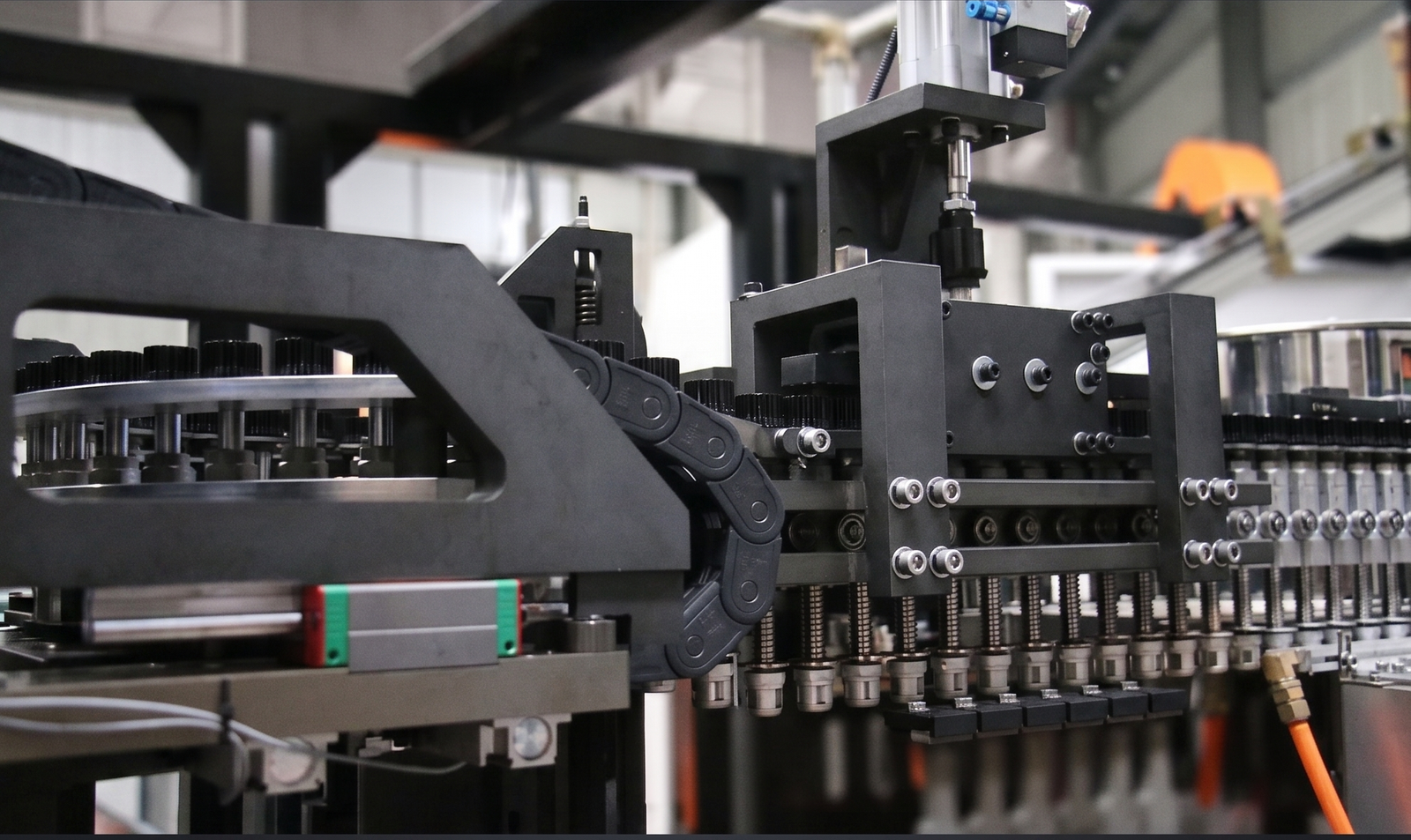
To the untrained eye, a finished PET container appears to be purely the product of high-pressure air and rigid tooling. When a packaging line encounters structural failures—such as wall thinning, base deformation, or container blowouts—the immediate instinct on the factory floor is to tweak the blow moulding machine parameters.
In a standard two-stage stretch blow moulding (ISBM) workflow, the final container is the physical summation of upstream variables. These range from resin moisture content and injection-phase thermal history to preform wall concentricity and infrared oven dynamics. Understanding this lifecycle connection allows plant engineers to move away from constant reactive firefighting and solve root-cause anomalies.
The genesis of a flawless PET bottle occurs long before the preform enters the blowing wheel. Because Polyethylene Terephthalate is a hygroscopic polymer, improper raw material drying can cause moisture to chemically attack the polymer chains during injection (hydrolysis), triggering a sudden drop in intrinsic viscosity (IV).
Furthermore, two preforms can share identical weights and dimensions on paper yet react completely differently under identical infrared oven settings due to structural variations like internal stress distribution, wall thickness eccentricity, or batch resin age.
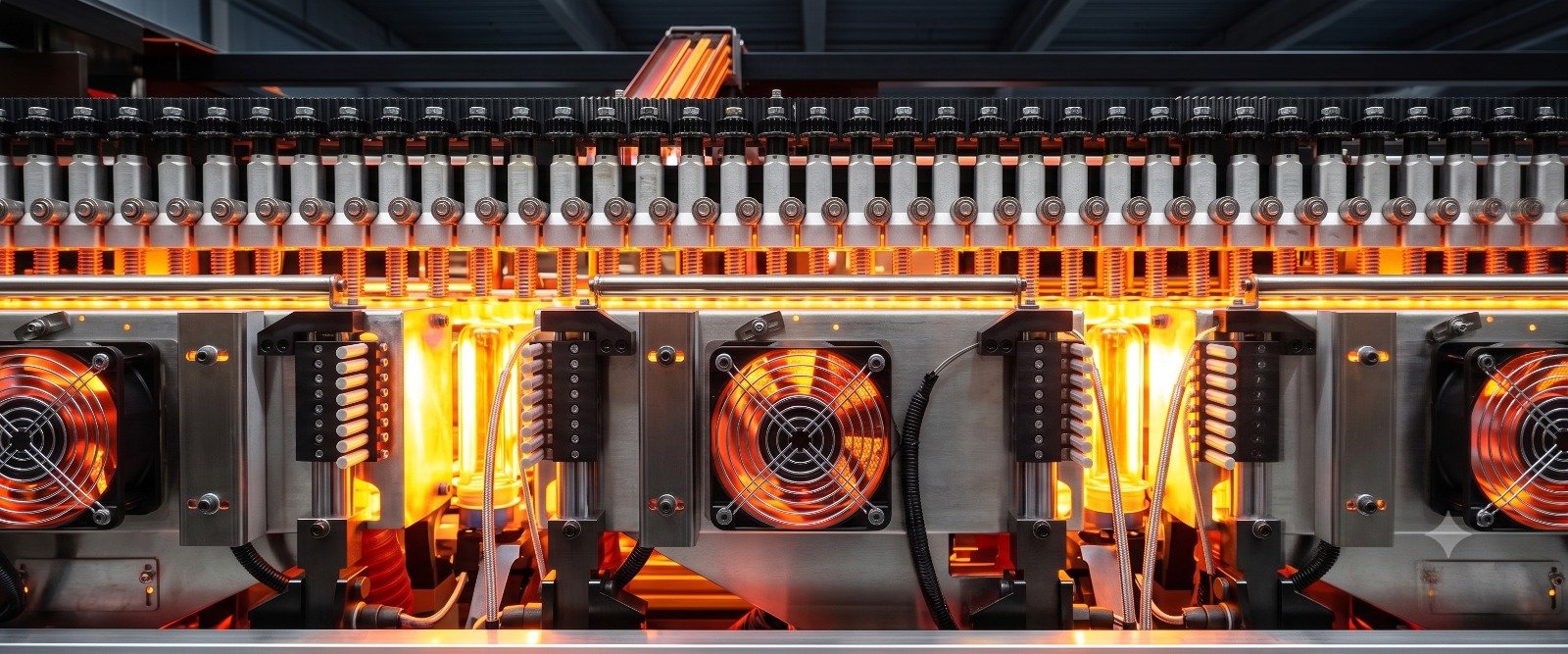
The objective of the heating zone is not merely to make the preform hot, but to achieve a precise, predictable thermal profile. If ventilation is inadequate or lamp banks are mismanaged, localized hot spots develop.
When over-heated plastic enters the mould, it loses its elastic resistance prematurely during pre-blowing, causing thin shoulders or localized wall collapse. Conversely, areas that remain too cold resist mechanical stretching, resulting in high-stress whitening (pearlescence) and structural fragility.
| Observed Bottle Defect | Primary Upstream / Process Root Cause |
|---|---|
| Uneven Wall Thickness | Preform eccentricity, irregular heating profile, or mistimed stretch rod descent. |
| Container Blowout / Split | Excessive preform moisture (hydrolysis), localized overheating, or premature high-pressure air entry. |
| Surface Whitening (Pearlescence) | Material stretched below its ideal thermal window or over-stretched past its natural limit. |
| Poor Base Formation / Rocking | Inadequate base cooling circuitry, low gate temperature, or restricted stretch rod clearance. |
| Dimensional Drift & Shrinkage | Fluctuating ambient oven temperatures, unstable chiller flow rates, or aged preform batches. |
When operators experience quality drift, changing multiple PLC settings at once compounds errors. A structured, step-by-step diagnostic sequence yields faster, permanent resolutions:
Solving PET bottle defects requires looking beyond the blowing wheel. True process optimization treats preform quality, thermal preparation, mechanical stretching, and blow moulding as a single connected system.
Global PET Industries Limited manufactures Semi-Automatic, ECO Series, Fully Automatic, and All-Electrical Servo blow moulding solutions engineered to deliver exact process control, operational stability, and long-term energy efficiency.