
When investing in capital machinery, initial procurement price is usually the first metric discussed. Experienced packaging manufacturers, however, ask a far more strategic question: What will this machine cost us per bottle over a 5 to 10-year operational lifecycle?
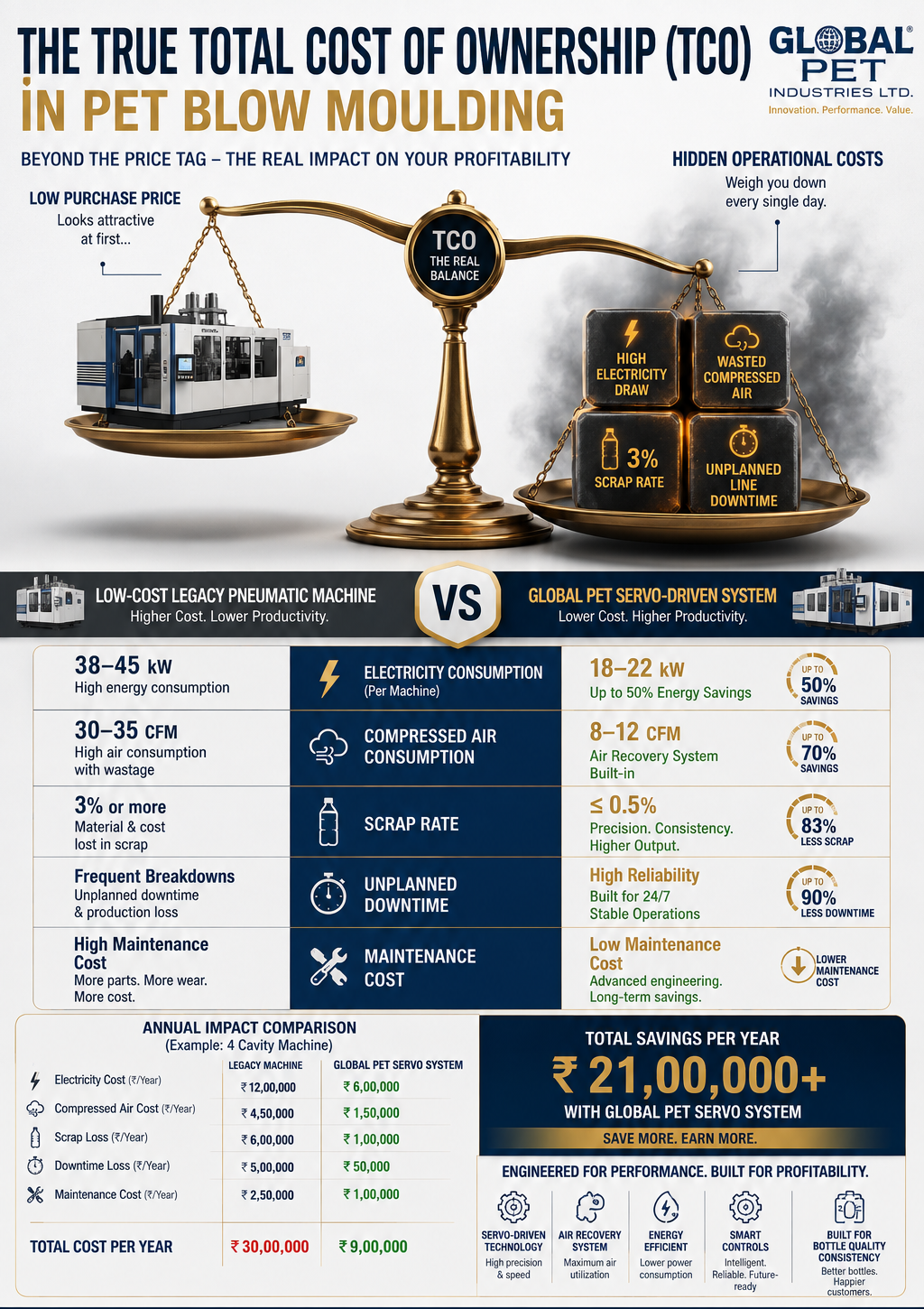
A lower purchase price can look compelling on a capital expenditure quotation. However, if that machinery consumes excessive electricity, wastes high-pressure compressed air, suffers elevated scrap rates, and requires frequent maintenance stoppages, the initial savings evaporate within the first few months of 24×7 manufacturing.
In high-speed PET packaging, purchase price represents only a fraction of total investment. The true metric driving long-term profitability is Total Cost of Ownership (TCO).
- Machine Purchase Quotation
- Freight & Duty Logistics
- Basic Installation & Commissioning
- Initial Tooling / Mould Packages
01. Initial CapEx vs. Lifetime Operational Overhead
Consider two machinery investment options: Machine A has a significantly lower purchase price, while Machine B requires a higher initial investment. Evaluating only initial capital costs makes Machine A seem like the obvious choice. However, once continuous production begins, operational efficiency dictates net margins:
If Machine A consumes 15% more power, wastes 20% more high-pressure compressed air, and incurs a 2% higher rejection rate, its cumulative operating overhead will exceed the purchase price difference within 12 to 18 months of continuous production.
02. Energy Consumption: The Silent Profit Drain
PET blow moulding relies heavily on thermal and pneumatic power. Infrared heating lamps and high-speed mechanical clamping demand continuous electrical energy. Running inefficient heating channels 24 hours a day, 365 days a year compounds utility costs significantly over a 10-year lifecycle.
03. Don't Ignore Compressed Air Efficiency
High-pressure air (25 to 40 bar) generation represents one of the highest utility costs in a bottle blow moulding plant. Outdated valve architectures, long pneumatic lines, and an absence of recovery systems drive up compressor workloads.
Modern servo-driven equipment featuring integrated air recovery captures exhaust air from the final blowing stage and redirects it to lower-pressure pneumatic operations, significantly reducing total compressor energy draw.
04. The True Financial Impact of Rejection Rates
Every scrapped bottle represents more than just a ruined PET preform—it wastes the electrical energy, compressed air, machine time, and labor needed to produce it.
A machine that achieves higher rated cycle speeds but delivers a 3% scrap rate due to thermal fluctuation or clamp flex is ultimately less profitable than a precisely controlled servo machine operating at near-zero defect rates.
The Unit Cost Calculation Formula
Cost Per Bottle = [ (Resin Expense + Power kWh + Air Utility + Labor + Maintenance + Scrap Loss) / Total Good Containers Yielded ]. A lower-priced machine with high energy draw and elevated scrap rates directly inflates your unit cost, shrinking margins on every delivered order.
05. Financial Consequences of Machine Downtime
Unplanned machine stoppages interrupt plant operations. Downstream filling lines go idle, delivery schedules fail, and customer relationships are impacted. Mechanical reliability, accessible component design, and robust preventive maintenance capability protect plant productivity.
06. Accelerating Mould Changeover Efficiency
Modern packaging plants often run multiple bottle SKUs. Rapid, repeatable tooling changeovers minimize non-productive downtime during SKU transitions.
Quick-change monoblock mould interfaces cut changeover times from hours to minutes. Across hundreds of shift transitions annually, these saved minutes add up to days of additional production capacity.
07. Technological Advantage: Servo Precision
Legacy pneumatic systems rely on mechanical stops and pneumatic valves that wear over time, causing parameter drift. Modern servo-driven architectures deliver precise, closed-loop digital control across critical machine movements:
Servo indexing, precise mechanical stretch control, and quick clamping locks ensure repeatable material distribution, consistent wall thickness, and reduced cycle times without mechanical shock.
08. Precision Monoblock Mould Technology
Blow moulding performance depends on its tooling interface. Precision monoblock moulds with engineered cooling channels provide uniform heat dissipation, clean detail reproduction, and faster cycle times while reducing wear on machine clamping components.
09. After-Sales Technical Partnership
Machinery performance relies on continuous vendor support. Developing new container geometries, lightweighting preforms, or executing preventive maintenance audits requires qualified technical assistance. A reliable machinery partner provides readily available spare parts, rapid field service, and ongoing technical guidance.
10. A 10-Point ROI Evaluation Checklist
Before selecting a PET blow moulding machine, evaluate these critical operational factors to determine long-term ROI:
Why Global PET Focuses on Total Manufacturing Value
At Global PET Industries Limited, our machinery is engineered to deliver lower lifetime operating costs. Our design approach centers on total manufacturing value: high output, precise energy control, durable mechanics, and dependable technical service.
From servo-driven blow moulding machinery and monoblock mould designs to complete installation, commissioning, and operator training, we help ensure your plant delivers high production yield, low unit costs, and long-term business growth.