
Every PET bottle manufacturer starts with the exact same objective: run the plant efficiently, produce high-quality containers, and maximize profitability. Yet two facilities with identical footprint capacities often deliver drastically different business results.
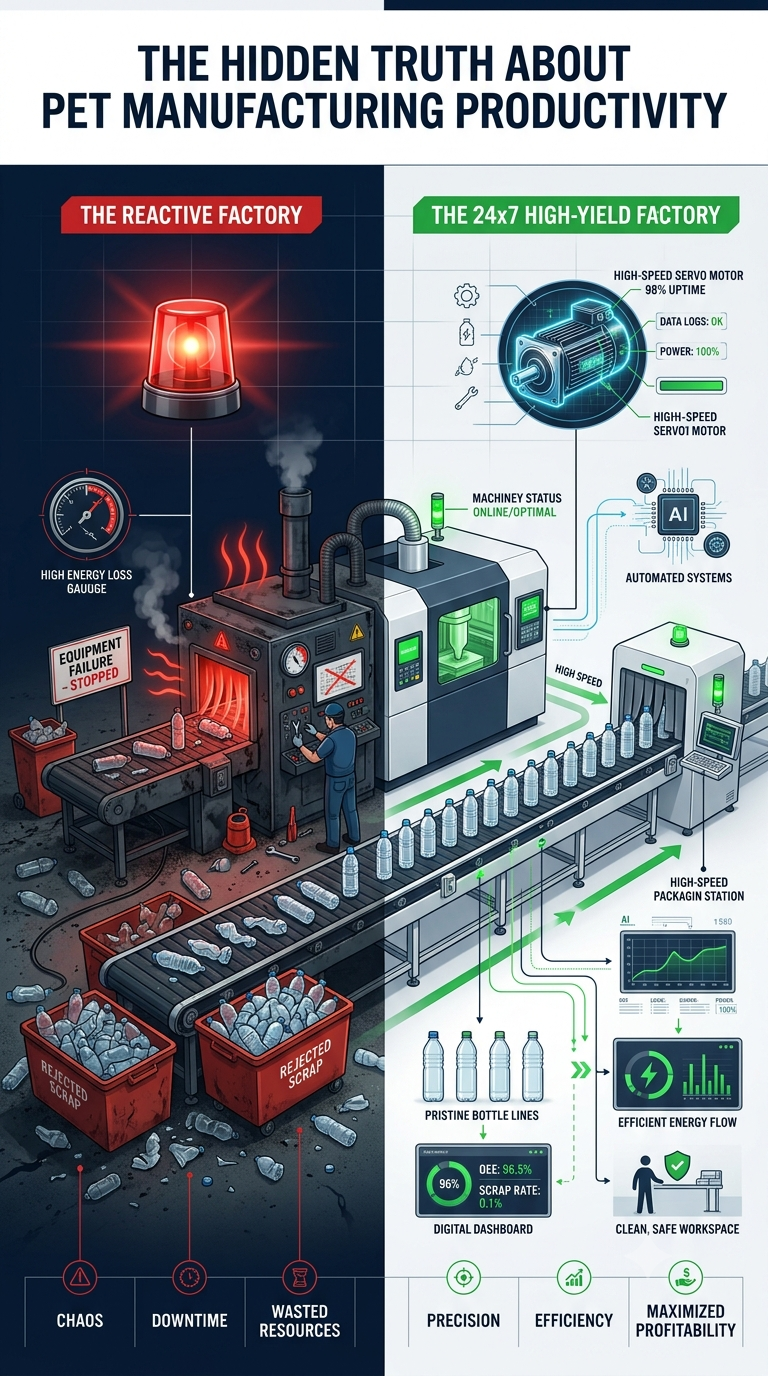
One plant operates 24 hours a day, consistently meeting demanding production targets with minimal friction. The other struggles daily with unexpected machine stoppages, rejected bottle batches, rising utility costs, and missed delivery schedules. The difference rarely comes down to luck; it is driven by the performance of the entire manufacturing ecosystem.
- Frequent unbudgeted line stoppages
- Trial-and-error parameter changes
- High scrap rates and resin wastage
- Reactive "run-to-failure" maintenance
- Compromised delivery timelines
- Predictable continuous machine uptime
- Data-driven, precise process parameters
- Consistent bottle quality and structural integrity
- Scheduled, rigorous preventive maintenance
- Optimized Total Cost of Ownership (TCO)
Here are the 7 core operational differences that distinguish continuously running PET plants from those stuck in daily stoppage cycles.
01. Choosing Total Value Over Initial Purchase Price
A common pitfall in equipment selection is evaluating machinery purely on initial capital expenditure (CapEx). High-volume manufacturing demands a focus on Total Cost of Ownership (TCO).
An under-engineered machine with a low initial price tag quickly becomes expensive when plagued by thermal instability, pneumatic leaks, frequent mechanical failure, and unoptimized energy consumption. Top-performing plants select equipment based on lifetime operational efficiency and structural reliability.
02. Strict Raw Material & Preform Quality Control
Even the most advanced blow moulding machine cannot compensate for defective or inconsistent preforms. Subtle variations in preform quality inevitably manifest as major blow moulding failures.
- Weight & Wall Variation: Triggers non-uniform stretch distribution and localized thin spots.
- Moisture Contamination: Causes structural haze, brittleness, and lowered top-load strength.
- Gate & Injection Imperfections: Leads to base blowout defects under high-pressure expansion.
03. Shift from Reactive Repair to Preventive Maintenance
Waiting for a component to fail before servicing it guarantees unscheduled downtime during critical production cycles. High-uptime plants follow disciplined preventive maintenance schedules.
Regular inspection of high-pressure pneumatic seals, mechanical stretch rod alignments, chilled water lines, and infrared heating lamps eliminates unexpected breakdowns and extends equipment longevity.
04. Eliminating Process Adjustments Based on Guesswork
When defects like banana bottles, neck ovality, or base collapse occur, untrained operators often alter heating profiles or blowing pressures at random. This masks underlying root causes while creating new instability elsewhere in the cycle.
24×7 manufacturing environments rely on standardized, data-backed parameter profiles calibrated for specific bottle geometries, ensuring repeatable production outcomes across shifts.
The Metric That Matters: OEE (Overall Equipment Effectiveness)
True profitability is determined by measuring OEE—a combination of Availability, Performance Rate, and Quality Yield. A plant running at 95% OEE generates significantly higher net margins than a plant running at 70% OEE with constant stoppage cycles, even if both operate the same number of shift hours.
05. Investing in Skilled, Well-Trained Operators
Modern blow moulding equipment relies on precise coordination between servo kinematics, heating dynamics, and pneumatic pressure timing. Highly trained operators understand process physics rather than just pushing buttons.
Empowering plant technicians with technical training enables rapid diagnosis of subtle parameter shifts before they escalate into full line stoppages.
06. Prioritizing Energy & Utility Efficiency
Electrical heating and compressed air generation account for the vast majority of ongoing operating expenses in a PET facility. Outdated, energy-inefficient systems drive up cost-per-bottle metrics.
Integrating modern servo-driven blow moulding equipment with air recovery technology captures exhaust pressure and repurposes it for low-pressure pneumatic operations, significantly reducing compressor load and lowering overall energy costs.
07. Partnering with Reliable Technical Support
Unplanned downtime is often prolonged by slow spare parts delivery or limited technical guidance from machine vendors. High-performance plants build partnerships with responsive machinery manufacturers who provide robust after-sales support, readily available spares, and on-demand engineering assistance.
The Global PET Engineering Advantage
At Global PET Industries Ltd., equipment supply is only the first step. We partner with bottle manufacturers to build high-yield, uninterrupted production environments by providing:
- Advanced Servo-Driven Technology: Engineered for high repeatability and low utility consumption.
- Complete Process Optimization: Hands-on technical parameter calibration for complex geometries.
- Comprehensive Operator Training: Upskilling your plant personnel for self-sufficient troubleshooting.
- Rapid Service & Spare Support: Minimizing line stoppages to protect your production targets.