
Look around you—from packaged drinking water and carbonated soft drinks to edible oil, pharmaceuticals, personal care, and household cleaning agents. Diverse fast-moving consumer goods (FMCG) sectors share a critical foundational element: high-performance PET packaging.
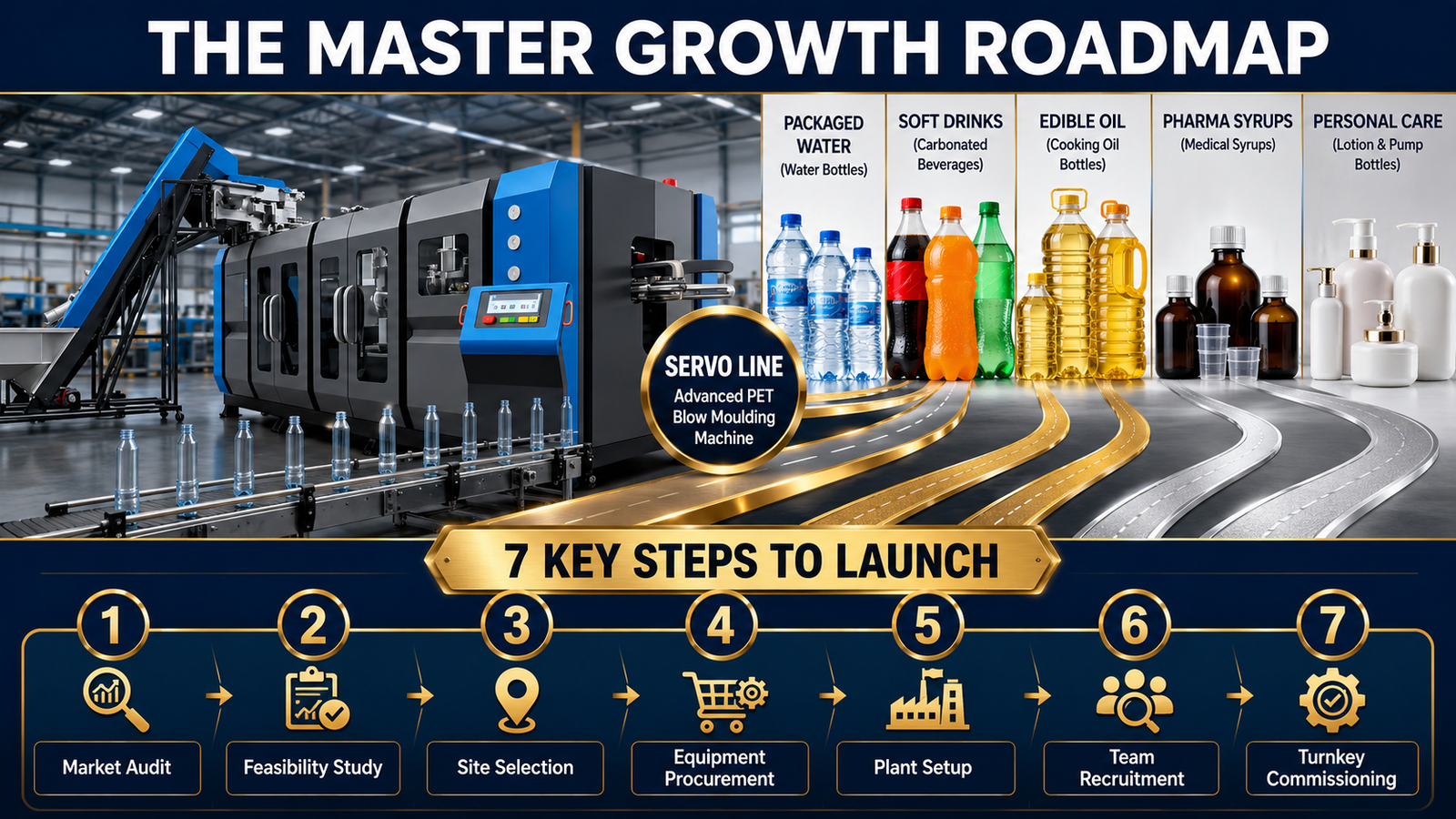
Polyethylene Terephthalate (PET) has established itself as the global standard in modern packaging due to its unique combination of tensile strength, lightweight construction, high clarity, convenience, recyclability, and design flexibility.
This creates a sustained opportunity for packaging manufacturers and prospective entrepreneurs: demand for PET containers spans a broad industrial ecosystem rather than relying on a single market segment.
01. Primary Drivers of Global PET Packaging Growth
Consumer goods companies require packaging solutions that deliver structural integrity and production efficiency at scale:
- Lightweight & Cost-Effective Transport: Reduces freight charges and carbon footprint per unit volume shipped.
- Impact Resistance & Durability: Eliminates transit breakage compared to conventional glass packaging.
- High-Clarity Product Presentation: Enhances shelf presence and visual consumer confidence.
- Design Versatility & Customization: Enables diverse neck finishes, custom contours, and brand differentiation.
- High-Speed Automated Processing: Compatible with high-throughput filling and packaging lines.
02. Industrial Applications Driving Demand
💧 Packaged Drinking Water
High-volume continuous demand ranging from single-serve 250ml bottles to larger multi-liter family formats.
🥤 Beverages & CSDs
Carbonated soft drinks, juices, energy drinks, and ready-to-drink teas requiring strict top-load and barrier stability.
🛢️ Edible Oils
Demands precise material distribution to handle structural integrity across various bottle capacities.
💊 Pharma & Healthcare
Requires consistent wall thickness, strict dimensional tolerances, clean production environments, and secure neck seals.
🧴 Personal Care
Custom shapes and ergonomic designs for lotions, liquid soaps, and haircare products.
🧪 Household & Chemicals
Durable containers designed for detergents, cleaning solutions, and specialty industrial liquids.
03. Building a Sustainable Business Model
Starting a successful PET manufacturing enterprise requires more than purchasing standalone blow moulding machinery. It demands an integrated operational framework:
The Complete Manufacturing Ecosystem
System Capitalization Formula: [ Blow Moulding Machinery + Precision Moulds + Quality Preforms + High/Low Pressure Utilities + Water Chillers + Operator Skills + Quality Assurance + Customer Logistics ]. Sustainable margins depend on optimizing every link in this chain.
04. Technical Overview: The Stretch Blow Moulding Process
Understanding the core engineering cycle is essential before capital deployment:
05. Engineering Precision: Tooling & Servo Integration
Machine performance depends heavily on mould engineering and motion control systems. Monoblock mould architecture with optimized cooling circuits ensures consistent container dimensions, reduced cycle times, and minimal thermal stress.
Integrating digital servo technology across clamping, stretching, and transfer mechanisms delivers precise repeatability, lower energy consumption, and quieter operation compared to legacy pneumatic systems.
06. Key Factors Shaping Capital Investment
Capital requirements vary based on target output, automation level, and plant infrastructure:
- Production Output Targets: Cavity configuration and rated machine speed.
- Container Specifications: Volume, neck finish, structural geometry, and bottle weight.
- Utility Requirements: High-pressure air compressor plants, chillers, and electrical infrastructure.
- Automation Level: Automatic preform loading, bottle inspection, and downstream conveyor integration.
07. Plant Economics & Operating Margin Drivers
Fundamental Financial Equation
Operating Profit = Net Revenue (Saleable Units × Unit Price) − [ Raw Preform Costs + Power (kWh) + High-Pressure Air Utility + Direct Labor + Scrap Wastage + Facility Overhead ]. Focus on maximizing saleable yield per shift to protect profitability.
08. Shift Focus to Saleable Production Yield
Evaluations based solely on nameplate speed can be misleading. Operating profitability depends on Saleable Bottles Delivered Per Day rather than ideal rated cycles per hour. Minimizing scrap and reducing downtime directly impact plant returns.
09. Precision Lightweighting Strategies
Material cost accounts for a major share of total bottle unit cost. Advanced lightweighting reduces preform weight while maintaining essential top-load strength, thermal stability, and drop resistance through optimized resin distribution.
10. A Strategic 7-Step Market Entry Framework
11. Scalability: From Initial Line to Enterprise Growth
12. Machinery Procurement Evaluation Checklist
Partnering with Global PET Industries Ltd.
Since 1996, Global PET Industries Ltd. has partnered with packaging manufacturers to design, build, and optimize high-efficiency production lines. Our capabilities include:
- Fully Automatic & Servo-Driven Machines: High-speed platforms built for precision, repeatability, and low energy draw.
- Semi-Automatic Systems: Reliable options for specialized, lower-volume production requirements.
- Custom Mould Engineering: Precision monoblock tooling designed for fast cooling and structural performance.
- Turnkey Engineering Support: Line layout design, installation, commissioning, process trials, and operator training.