
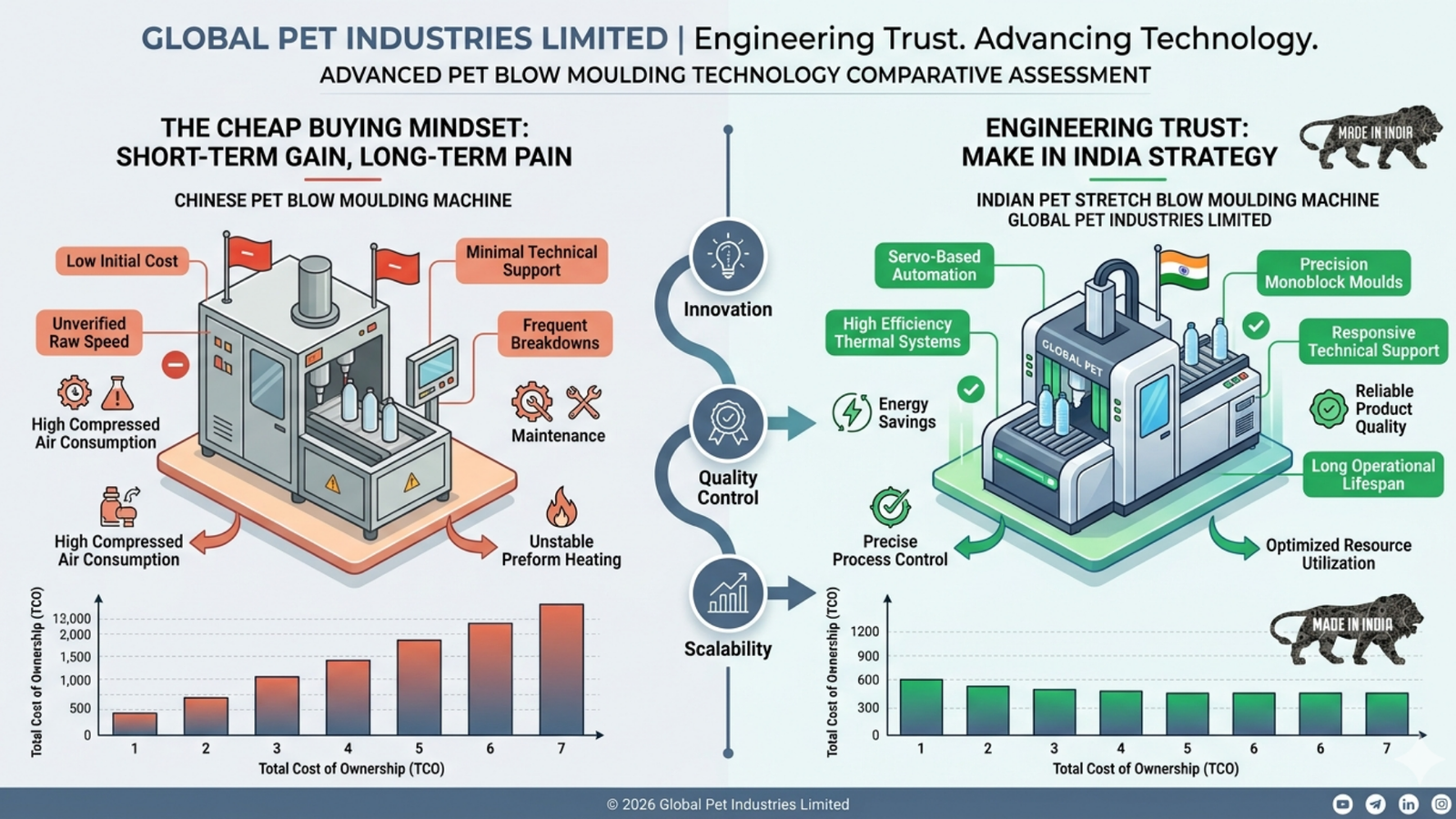
Comparative Industrial Assessment: Global Machinery Deployment Factors
India currently maintains one of the world's fastest-growing manufacturing sectors. The nation is backed by highly skilled engineers, resilient entrepreneurs, and an expansive domestic market. Despite these immense native advantages, a significant cross-section of modern industries still depends heavily on imported machinery—particularly options sourced from China.
This reality prompts critical operational questions: Why does this systemic dependence persist? Why do Chinese machine manufacturers continue to expand their global market share despite ongoing industrial complaints regarding machine life, after-sales support, and structural quality issues? Most importantly, can Indian manufacturers build global-level machinery brands capable of shifting this dynamic?
The answer is definitively yes. However, this transformation can only occur if the domestic industry accurately understands the systemic and psychological challenges behind long-term industrial growth.
The Core Obstacle: The "Cheap Buying Mindset"
The primary barrier to accelerating domestic manufacturing quality is a widespread purchasing philosophy that prioritizes short-term capital expenditures over total cost of ownership (TCO). Many buyers evaluate capital machinery using a limited set of immediate metrics:
The Short-Term Focus
Purchasing choices driven primarily by:
- Initial purchase price considerations
- Unverified raw speed claims
- Immediate delivery timelines
The Real Capital Impact
Critical long-term variables frequently ignored:
- Long-term structural maintenance costs
- Daily operational energy consumption
- Total machine operational lifespan
- Production cycle stability and spare availability
This dynamic creates a highly restrictive operational loop: purchasing low-cost machinery leads to frequent component breakdowns, resulting in inconsistent production outputs, depleted margins, and an inability to fund industrial expansion. Conversely, global market leaders anchor their operations around engineering precision, deep automation, long-term operational reliability, systematic energy savings, and consistent product quality. This alternative focus is how industrial enterprises scale sustainably.
Decoding the Accelerated Growth of External Competitors
It is an industrial misconception that international competitor dominance was achieved solely through low pricing. The rapid scaling of these machinery networks relies on four structural pillars:
- Massive Integrated Supply Ecosystems: Manufacturing hubs ensure localized, immediate availability of electronics, high-grade servo systems, fabrication facilities, automation components, precision tooling, and heavy casting. This density lowers production costs and accelerates time-to-market.
- Aggressive Global Export Strategies: Early international market entries were backed by massive production capacities, volume manufacturing capabilities, fast supply turnarounds, and highly competitive entry-level pricing structures.
- Targeted Institutional Manufacturing Support: Manufacturing enterprises benefited directly from robust industrial infrastructure, dedicated manufacturing zones, structural export incentives, and streamlined administrative approval processes.
- Continuous Technology Upgradation Cycles: Small and mid-sized enterprises consistently re-invested capital into engineering upgrades, integrating advanced servo technologies, robotics, automation systems, and high-precision tooling.
The Long-Term Capital Realities
While low-cost imported machinery configurations often look financially viable on a preliminary balance sheet, they frequently introduce severe hidden operational costs over time. Industrial operators routinely face high compressed air consumption, unstable preform heating dynamics, highly inconsistent bottle finishes, elevated component rejection rates, an increased reliance on manual intervention, minimal technical support networks, and severely shortened equipment lifespans.
Over a standard 5-to-7-year operational lifecycle, the cumulative financial drain of unexpected downtime, wasted raw materials, and high energy utilization far outweighs the initial acquisition savings.
Elevating the Mandate for "Make in India"
The "Make in India" initiative extends far beyond simple geographic manufacturing. It represents a fundamental shift toward establishing deep engineering confidence, innovating proprietary global technologies, reducing structural import dependencies, sustaining local technical employment, and building resilient industrial supply bases.
India is fully positioned to evolve into a primary global machinery hub, provided manufacturing facilities realign their strategic focus around continuous innovation, strict quality control, precision engineering execution, deep automation integration, and long-term capital horizons.
Five Strategic Pillars for Global-Scale Growth
To successfully compete with global engineering giants, domestic machinery manufacturers must execute five core transitions:
- Prioritize High Engineering Execution over Price: Long-term market share is consistently won through technical performance and process control.
- Capitalize on Modern Automation: Future profitability relies on integrating precision servo systems, advanced robotics, high-efficiency moulding, and optimized energy management frameworks.
- Establish Highly Responsive Technical Support: Long-term client retention is anchored by technical support organizations that eliminate unscheduled downtime.
- Advance Internal Manufacturing Standards: Precision production execution directly results in superior container clarity, lower rejection rates, reduced component wear, and elevated client trust.
- Adopt Extended Strategic Horizons: Lasting industrial brands are built systematically over time through consistency, technological innovation, and reliable engineering execution.
Global PET’s Vision
Since 1996, Global PET Industries Limited has systematically dedicated its engineering resources to pioneering advanced PET stretch blow moulding technologies. Our focus centers on integrating servo-based automation, designing energy-efficient thermal systems, manufacturing precision monoblock moulds, and delivering complete, turn-key PET packaging solutions.
Our ultimate objective goes far beyond basic machine assembly; we are actively invested in engineering a highly competitive, technologically advanced, and self-reliant domestic manufacturing ecosystem.
Conclusion
The necessary engineering talent, domestic market scale, and design capabilities are completely present within the region. The path forward demands an unyielding confidence in domestic manufacturing capabilities, purposeful capital investment into advanced machinery platforms, and a commitment to long-term industrial planning. The future belongs decisively to enterprises that innovate rather than those that compete solely on baseline cost.